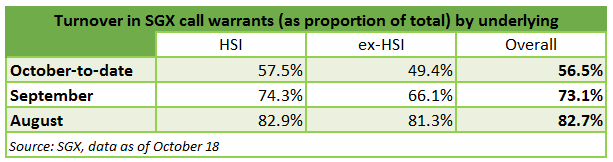
Interest in bearish bets on the warrants market in Singapore grew substantially in October, as compared with recent months, according to the latest warrants trade data from Singapore Exchange (SGX), released on Wednesday. Turnover on the warrants market as of October 18, 12 trading days into the month, stood at S$327m (US$235m). With nine trading days to go, the market is on track to record a second month in a row of turnover declines, after the spectacular run to August.
The drop in overall activity coincides with a sizable increase in investor interest in 'put', or bearish, warrants. While 'call', or bullish, bets dominated the market over the past few months, led by a rally in the Hang Seng Index (HSI) - the traditionally overwhelming underlying in the market, investors have noticeably shifted views since September.
"In theory, a rising put/call ratio indicates an increase in bearish views for the underlying indices. [However], the put/call ratio in itself does not give sufficient guidance to conclude the market is bearish now," said Luuk Strijers (pictured), head of products at the equities and fixed income division of the SGX. "Furthermore, the outstanding position reports per issuer as published on our website clearly show the outstanding dollar value in HSI calls significantly outweigh the positions in puts."
Less optimistic views on HSI, which accounts for between 80% and 95% of total warrants turnover in Singapore, have resurfaced over the past two months. The Hong Kong benchmark added just 1.4% in September and is flat October-to-date, which compares with 5.0% and 5.3% growth for the August and July, respectively.
Pessimistic views on the Hang Seng China Enterprise Index (HSCEI) and Nikkei 225 were even more apparent, with call trades on the two indices accounting for only 12% and 29%, respectively, down from 50% and 53% in September. However, volumes on the two indices are still very low at S$10-40m per month.
According to SGX data, 65.4% of the outstanding notional in warrants is in call bets.
Strijers noted that the general increase in bearish views, and the slowdown in trading activity, on SGX is in line with regional and global warrant trends.
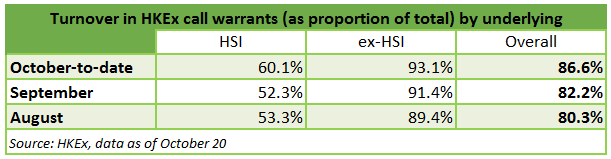
Hong Kong Exchange (HKEx), the biggest investment market in the region, also endured a sizable drop in warrant trade in September, with turnover dropping 10.3%. Hong Kong warrant investors remained highly optimistic, however, with calls accounting for 82.2% of trade for last month, and 86.6% in October-to-date. HSI continued attracting more balanced views, but the benchmark also saw a marked increase in bullishness in October-to-date.
The drop in SGX warrants turnover in September and October could be misleading, as activity is still significantly higher on an annual basis, Strijers argued.
"The warrants turnover on SGX this year has by far exceeded warrants turnover in calendar year 2015," said Strijers. "Even though the structured warrants value traded in September (S$769m) was down 7% month-on-month, it was up 147% year-on-year."
According to Strijers, trading activity for the remainder of the year would be difficult to predict in light of significant market uncertainty, including wavering economic growth in certain markets, the implications of Brexit and the result of the upcoming US elections.
Meanwhile, SGX reported first quarter FY2017 results yesterday, revealing a 13% drop in revenue on an annual basis to S$191m. Net profit was down 16% year-on-year to S$83m. Securities daily average traded value dropped 19% to S$0.99 billion, and the total traded value fell 17% to S$62.2 billion.
Apac warrants trading takes a dive amid market uncertainty
SGX boosts smart beta index capabilities
Hang Seng continues to dominate on Apac exchanges