
Experts highlight education, tax efficiency and distribution as central to the expansion of derivative-based ETFs.
Laura Elliot, head of Emea iShares product structuring and solutions at BlackRock started the panel sharing her observation on the evolution for exchange-traded funds (ETFs) since the advent of non-plain vanilla index in 2008.
[Defined outcome ETFs] seem complex under the hood, but the outcome is straightforward - Laura Elliot, BlackRock
“We’ve gone from index active into the structured product market,” said Elliot, noting the initial pushback that often accompanies innovation, including actively managed ETFs as well as those using synthetic exposures.
In the US, ETF investors have been familiar with structured outcomes “for a while”. However, the adoption in Europe and Asia has lagged where institutional investors -historically focused on plain-vanilla exposures - have dominated the market, according to the London-based senior structurer.
“But I do think it’s changing, because the client base is changing significantly. Digital [wealth] platforms are becoming very important. Investors are finding product products on their own,” said Elliot.
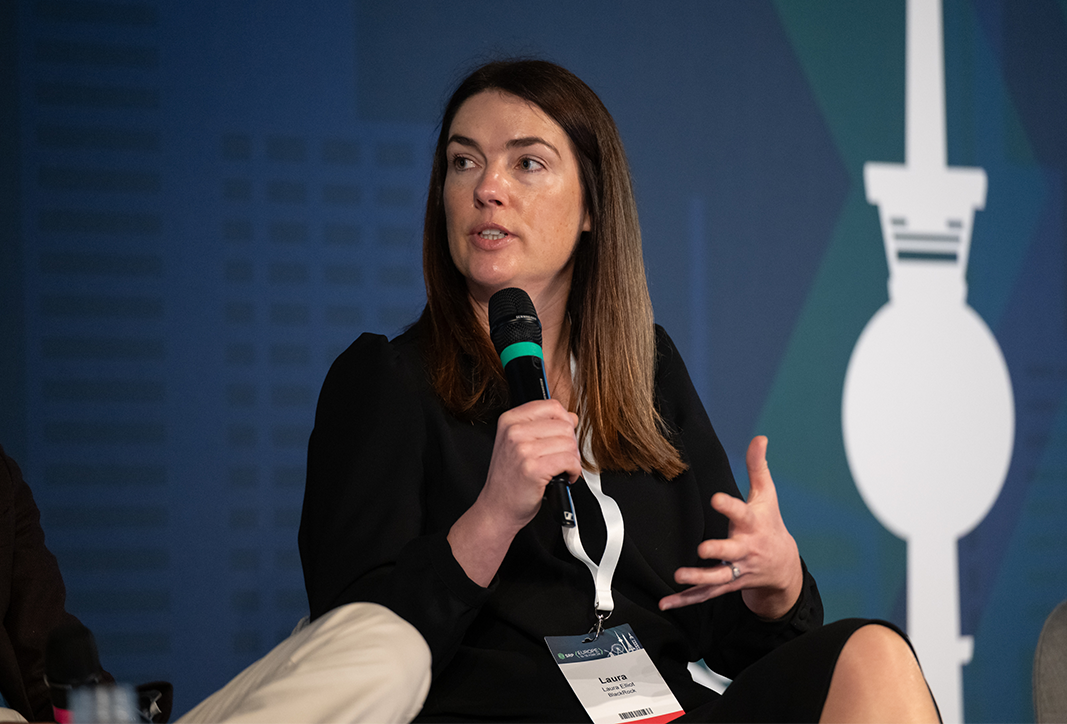
Laura Elliot, BlackRock
More recently she’s started to see more retail investors purchase ETFs through saving plans on digital wealth platforms.
At the same time, the evolution of regulatory and policy shifts across the UK and Europe encouraging individuals to move cash out of low-yield bank accounts are supporting broader ETF adoption.
“[Defined outcome ETFs] seem complex under the hood, but the outcome is straightforward. This comes down to education.” said Elliot. “These could be really good bridge products for the next sort of generation of investors that are coming in.”
There’s a need in the market for products that can help investors who are concerned weather the storm - Paul Bhushan, ARK
Rahul Bhushan, global head of investment product at ARK Investments, argued that heightened market uncertainty - partly driven by the disruptive impact of artificial intelligence (AI) - could accelerate demand for structured ETFs, which feature a range of payoffs including covered call, autocall and buffer/downside protection.
“I think there’s a need in the market for products that can help investors who are concerned weather the storm. That’s really going to be the big sort of impetus around the rise of these products,” said Bhushan.
He also highlighted distribution challenges in Europe, where banks continue to dominate access to structured products. However, digital wealth platforms are helping democratise access for retail investors.
The product manager further referenced an ongoing intergenerational wealth transfer across Europe. “That money trickles down. People become more familiar with these products. The education is happening,” he said.

Left to right: Deborah Fuhr, ETFGI; Rahul Bhushan, ARK Investments; Laura Elliot, BlackRock; and Aous Labbane (moderator), Jasmin Capital and Consulting
Deborah Fuhr (pictured), managing director at research and consultancy firm ETFGI, underscored the untapped potential among female investors, citing a September survey by The Investment Association in the UK.
The evolution has been registered investment advisors converting SMAs and private funds to ETF - Deborah Fuhr, ETFGI
The findings show that ETF investors tend to be younger, higher-income and male, with a quarter living in London. They are often relatively new to investing with 49% starting to invest in the last five years.
“This indicates a significant opportunity to broaden the base of ETF investors to reach different investor profiles including women and older demographics,” the survey finds.
In the UK, many women favour individual savings account (ISA), a tax-efficient account allowing individuals to save or invest up to £20,000 annually and often maintain a cautious approach by holding cash in bank accounts.
“I think these types of products are really a good gateway to get them to invest and help people feel a bit more comfortable that you're not going to lose everything,” said Fuhr. “And we are seeing that educational programmes are being rolled out by regulators, both in the UK and across Europe.”

Left to right: Deborah Fuhr, ETFGI; Rahul Bhushan, ARK Investments; Laura Elliot, BlackRock; and Aous Labbane (moderator), Jasmin Capital and Consulting
However, distribution remains a key hurdle. In the US, ETFs are more tax efficient than mutual funds and separately managed accounts (SMAs) and became more popular after the SEC paved the way in September for Dimensional Fund Advisors to add ETF share classes to mutual funds.
“What we’ve seen is the evolution has been registered investment advisors converting SMAs and private funds to ETFs while large asset managers convert mutual funds into ETFs,” said Fuhr.
Do you have a confidential story, tip or comment you’d like to share? Contact Us | SRP (structuredretailproducts.com)