Also, the artificial intelligence theme prompts investor interest in Micron Technology-linked ELS as Tesla loses momentum.
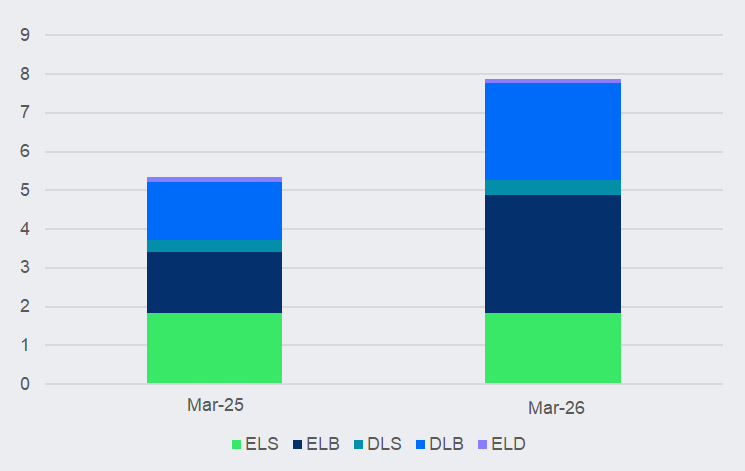
Sales of structured products in South Korea elevated to KRW7.89 trillion (US$5.3 billion) in March, jumping 47% year-on-year, SRP data shows.
The latest volumes also rebounded from the prior month’s dip, up 59% on a monthly basis.
Principal-protected product structures accounted for 70% of total volumes. Among, equity-linked bonds (ELBs)’ volumes soared over 91% to nearly KRW3.1 trillion during the month compared with the prior year’s same period. Derivatives-linked bonds (DLBs)’ volumes also rose 68% year-on-year (YoY) to KRW2.5 trillion.
“March 2026 was a period when the domestic bond market showed weakness due to geopolitical risks and a sharp appreciation of the Korean won, while stock market instability was extremely high,” Gyun Jun, derivatives strategist at Samsung Securities, wrote in a research note.
“This is believed to be the result of investors focusing their attention on ELBs, which are principal-guaranteed products, to hedge against stock market volatility,” Jun wrote.
South Korea: sales of structured products by wrappers (KRW trillion)
Source: SRP
Equity-linked securities (ELS), also known as capital-at-risk auocallable notes, recorded sales of KRW1.8 trillion in March. It was up 32% month-on-month (MoM), but roughly flat YoY.
Underlyings, payoffs
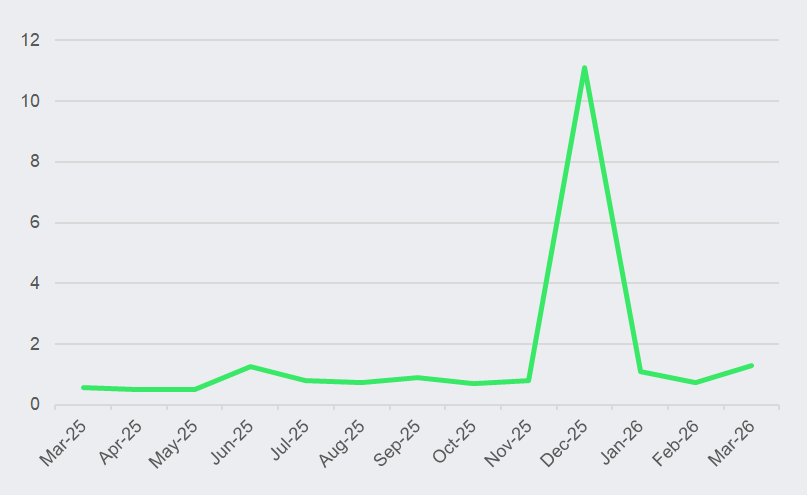
Samsung Electronics continued to lead the pack as the most-sold underlying for ELBs, with sales of KRW1.9 trillion (US$1.3 billion) tracking the Korean memory chipmaker’s stock and accounting for over 60% of ELB volumes. Most of these products were structured as single stocks.
The latest volumes of Samsung Electronics-linked ELBs also reflected a 1.2 times surge YoY and a 78% increase MoM.
South Korea: sales of ELB that incorporates Samsung Electronics exposure (US$ billion)
Source: SRP
The Kospi 200 and S&P 500 were also popular underlying exposures for ELBs, recording volumes of around KRW688 billion and KRW243 billion, respectively.
The digital payoff remained the most popular structure for ELBs, with KRW2.1 trillion in sales, followed by principal-protected autocall structures (KRW768 billion).
For non-principal-protected ELS, a basket of benchmark indices led by the Kospi 200 (KRW944 billion), S&P 500 (KRW916 billion), and Eurostoxx 50 (KRW772 billion) with a worst-of payoff remained favoured by investors in March.
Micron Technology eclipsed Tesla to become the best-selling stock underlying for ELS, logging sales of KRW192 billion during the month. Last year, only KRW4 billion of such American semiconductor manufacturer stock-linked ELS were sold. The majority of Micron Technology-exposed sales were structured in a basket of stock structures in March, mostly alongside other tech and semiconductor equities.
This coincided with Micron Technology’s shares surging 513% over the past year to US$426.56 by Monday’s close.
Tesla, hovering as the runner-up for stock underlyings during the month, gathered sales of KRW152 billion, down 54% YoY.
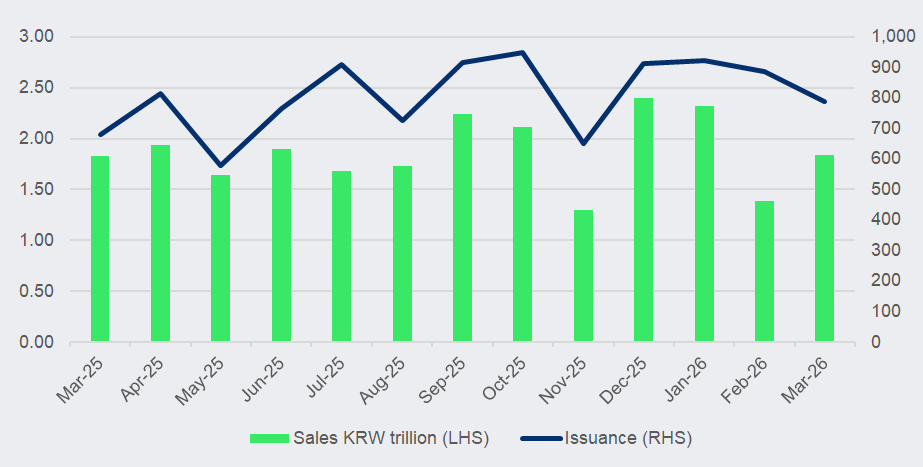
The overall ELS issuance dropped from some 880 products in the prior month to 789 products but remained higher than 681 in the prior year’s period.
South Korea: ELS - sales & issuance by month
Source: SRP
The dynamics of the distribution channel for ELS have also shifted: Over 65% of ELS were publicly distributed products during the month, lower from 80% a year ago, as more ELS products sold shifted to the private placement channel by volume.
For DLBs, Korea’s three-month treasury bond remained the most-favoured asset, with sales jumping 48% YoY to KRW2 trillion in March.
This is followed by the 91-day certificate of deposit rate (KRW245 billion), which surged two times compared with last year’s same period. The USD/KRW pair-linked DLBs also recorded KRW185 billion in sales, 1.4 times higher YoY.
South Korea: top three underlying used in DLBs in March 2026 (KRW trillion)
| Top underlying | Sales volume |
| Korea Treasury Bond 3M | 2.00 |
| Certificate of Deposit Rate 91d | 0.25 |
| USD/KRW | 0.19 |
Source: SRP
Gold and copper were also seen constructed into a DLB trade in March. Issued by Hana Securities, the one-year product was sold for KRW10.3 billion through a private placement.
Meanwhile, a worth of KRW373 billion in derivatives-linked securities (DLS) were issued in March, a capital-at-risk product with most of the issuances usually focusing on credit. Sales were up 29% YoY and 50% on a monthly basis.
Under this wrapper, however, a hybrid product of the S&P 500 Total Return index and the USD/KRW FX pair gained the most traction by sales, recording roughly KRW68.3 billion in sales. Shinhan Securities was the issuer for this private placement trade.
Issuers
Korea Investment & Securities (KIS) beat February’s top issuer, Hana Securities, to lead the league table for March as the largest structured product issuer in the country across the wrappers.
The Seoul-based securities house sold KRW1.03 trillion worth of products during the month, almost doubling from last year’s same period.
KIS was followed closely by Shinhan Securities, which recorded sales of KRW1.02 trillion, a 1.2 times higher YoY.
South Korea: top 10 issuers by sales in March 2026 (KRW billion)
| Issuer | Sales volumes (KRW billion) |
| Korea Investment & Securities | 1,029 |
| Shinhan Securities | 1,023 |
| Kiwoom Securities | 804 |
| Hana Securities | 675 |
| Hanwha Investment & Securities | 549 |
| Shinyoung Securities | 469 |
| Yuanta Securities (Korea) | 451 |
| Daishin Securities | 446 |
| NH Investment & Securities | 354 |
| Mirae Asset Securities | 324 |
Source: SRP
Kiwoom Securities (KRW804 billion), Hana Securities (KRW675 billion), and Hanwha Investment & Securities (KRW549 billion) hovered at third, fourth, and fifth for the month, respectively.
A three-month Korea treasury bond-linked DLB issued by Kiwoom Securities made it into the country’s best-selling structured product of the month, recording sales of KRW500 billion.
Eight out of the top 10 selling products in March were all principal-protected, with other issuers including Shinhan Securities, Korea Investment & Securities, Hanwha Investment & Securities, and Daishin Securities.
Looking ahead
Market participants in Asia pondered the heightened volatility and its impact on the structured products world following the tensions in the Middle East and Iran in March. Sources told SRP that hedging activities around autocallable notes issued in Korea might not be a major factor in amplifying volatility.
During a 12 March meeting, the Financial Supervisory Service warned of widening valuation gaps in commodity exchange-traded funds (ETFs) and exchange-traded notes (ETNs) amid Middle East-driven volatility.
This month, the country’s financial watchdog held a meeting emphasising strengthening risk management and implementing precautions regarding product manufacturing and sales for exchange-traded funds (ETFs) and equity-linked deposits (ELDs).
Image: Efired/Adobe Stock
Do you have a confidential story, tip or comment you’d like to share? Contact Us | SRP (structuredretailproducts.com)
Disclaimer: While SRP's aim is to provide accurate and up-to-date information, the data provided is gathered from third parties. SRP does not take responsibility for the accuracy of the data and will not be held liable for any errors or omissions contained in the information provided. The information and data included on SRP's market reports uses sources believed to be reliable. SRP assumes no liability or responsibility for the quality, content, accuracy or completeness of the information, text, graphics, links and any other items contained in this report.