
Strategy Allocation can provide a framework for integrating structured products, AMCs and risk-control strategies as institutional investors seek more precise portfolio outcomes.
Strategic Asset Allocation (SAA), coupled with Tactical Asset Allocation (TAA), remains the standard among institutional investors when outlining an Investment Policy Statement (IPS). However, this traditional framework carries numerous drawbacks, notably placing rather strict limitations on how effectively an asset owner's market views can be implemented.
Here, we present the shift from the rigid SAA/TAA framework to a more adaptable Strategy Allocation model. This modern approach empowers investors to make the most of what the structured products world offers in terms of precise, easy-to-use financial instruments.
The SAA/TAA Framework
SAA is fundamentally long-term-oriented, assigning fixed percentage weights to various asset classes to achieve targeted expected returns over time. However, these future (average) returns must be specified in advance, alongside estimates for forward-looking volatilities and correlations. This introduces a heavy reliance on unpredictable variables. When run through Mean-Variance Optimization, the resulting portfolio is typically highly sensitive to even minor tweaks in these expected return estimates.
To compensate, Tactical Asset Allocation (TAA) allows investors to express shorter-term directional views, but only up to a point. TAA is typically bound to tighter allocation ranges around the SAA baseline. While it acts as the active management component, it inevitably requires rebalancing back to the original SAA targets. This introduces practical headaches: How often should you rebalance? In a strongly trending market, rebalancing forces you to cap your gains prematurely while the (up-)trend continues. Conversely, it requires the psychological discipline to buy an asset while it is falling - a feat much easier said than done.
In short, there is a strong need for an alternative approach to better manage institutional portfolios. Enter the Strategy Allocation model, a framework well suited to the integration of structured products.
The Strategy Allocation model
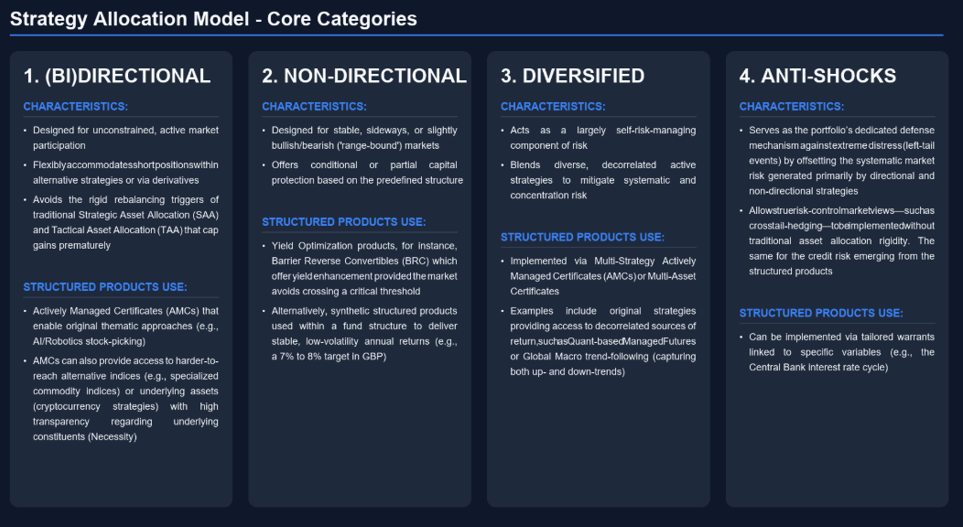
Rather than organizing a portfolio by traditional asset classes, modern institutional portfolios increasingly focus on the underlying risk and types of strategies deployed. Building on this philosophy, our Strategy Allocation framework categorizes investments into four core groups. The first three form the 'active return' engine: (bi-)directional, non-directional and diversified strategies. The fourth and final category is a dedicated risk-control bucket: what we call the “anti-shocks”.
Because market risk stems primarily from the directional and non-directional strategies (the diversified strategies are largely self-risk-managing), the anti-shock bucket acts as the portfolio's crucial defense mechanism.
This modern portfolio design greatly simplifies and extends the allocation process. It makes it substantially easier to align with investment objectives while respecting portfolio constraints, far outperforming the traditional SAA/TAA setup. Crucially, the investor’s true market views take center stage and rigid precautionary constraints on derivatives can be applied more flexibly.
Let’s illustrate this by using examples of structured products.
The use of structured products in a Strategy Allocation
In our recent article, “Special Edition: The Fund of Mimicked Structured Products,” we examined a large fund built entirely from synthetic structured products, incorporating exotic derivatives tied to a basket of equity indices. Its objective? Delivering stable, low-volatility annual returns of 7% to 8% in GBP over a mid- to long-term horizon, provided the market avoids severe distress.
Where does this fit into our new model? It’s a textbook non-directional strategy. The investor isn't banking on a sharp upward or downward market movement; the return target is clear and the risk remains below average under normal conditions. And what if the markets do crash? That is exactly where the anti-shocks category steps in to protect the portfolio.
Anti-shock strategies can also be seamlessly implemented via structured products (a topic we will explore in a separate piece). For instance, an Investment Bank might deploy warrants linked to short-term interest rates that address the Central Bank interest rate cycle.
As for the bi-directional category, active strategies are blended to create a diversified portfolio that can easily accommodate short positions and alternative assets. Through Actively Managed Certificates (AMCs), highly original approaches can be unlocked - whether that means thematic investments (like an AI and Robotics stock-picking portfolio differing from a classic dedicated index) or harder-to-access illiquid assets like cryptocurrencies. Critical here is ensuring a high level of transparency in order to properly deal with concentration risks and, when it comes to illiquid assets, recognizing the level of liquidity required to fulfill portfolio constraints.
In a nutshell: a graphical representation
Looking ahead: in the next article of our ongoing series covering structured products and the Greeks, we will break down the critical aspects of model risk for more complex structured products, complete with real-world examples.
Image: Miha Creative/Adobe Stock
Disclaimer: This content is not intended as a solicitation or an offer; it is provided solely for informational purposes to professional investors. The information presented herein has been prepared with great care; however, errors may still occur.