
In the third part of our “easy-language” series, we will discuss a very popular structured product payoff structure from the yield enhancement category: the reverse convertible.
Although there are various versions available today, we will focus on the “plain vanilla” variant.
A second structured product explained: reverse convertible (RC) from the “yield enhancement” category.
From the table in the first part of our article, here is the profile we have for “Yield Enhancement”:
| Category | Description | Exposure type/Beta relationship | Typical Investor View |
| Yield Enhancement | Enhance yield by selling volatility or downside participation (e.g., reverse convertibles, discount certificates). Capital protection is partial or absent. | Reduced or asymmetric beta; the investor gives up upside for additional yield. | Neutral to mildly bullish view – the investor expects stable or moderately rising markets. Especially, at maturity. |
Source: Evolids Finance
In terms of exposure, the (classic) reverse convertible is made of a combination of a (long) straight bond and a plain vanilla European-style short put option. There are two main differences with a straight bond:
The coupon is significantly higher than that of a straight bond.
The payout at maturity of the bond is either 100% of the initial investment or a pre-specified number of shares of the underlying company if the asset's price has fallen below a certain level, that’s the strike (resulting in an unrealized loss for the investor).
Because the investor fully funds the bond upfront - a large amount of money - their short put position cannot lead to a situation in which the investor owes money to the issuing bank. This means that the bank faces no credit risk from the investor defaulting. However, the investor still bears the credit risk of the issuing bank.
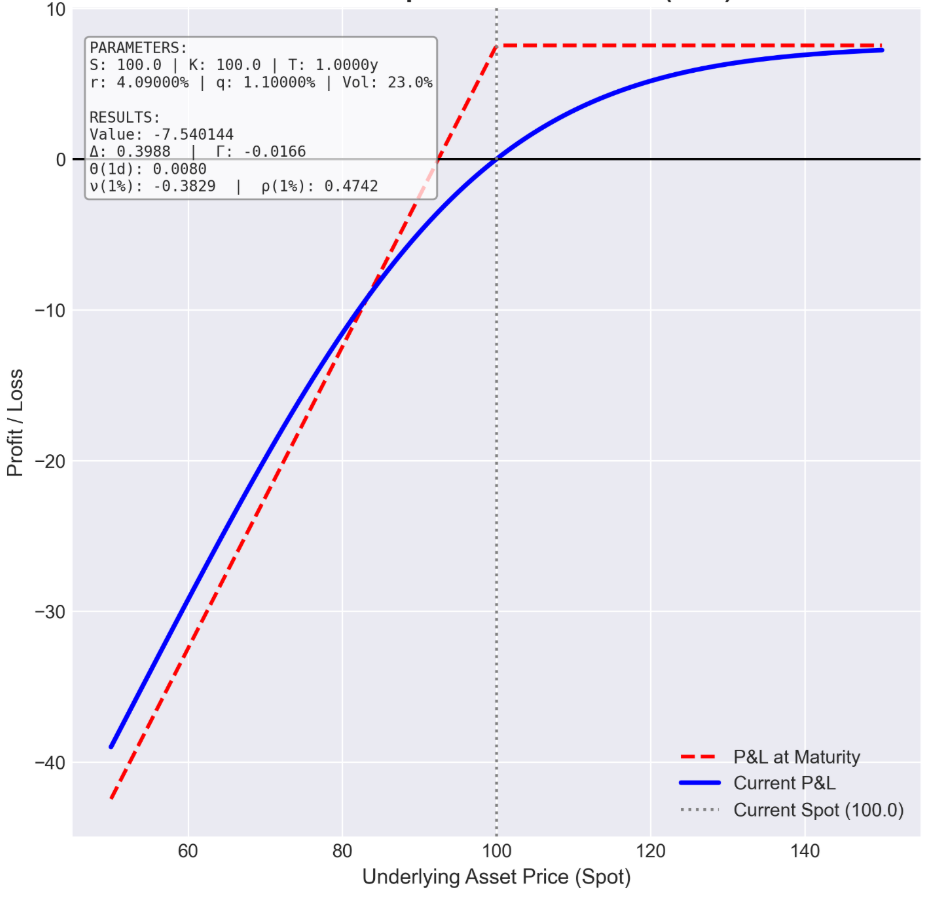
Below is the payoff graph at expiration for a European short put:
Short put option – profit & loss (P&L)
Source: Evolids Finance
Key characteristics of the reverse convertible
No financing level: reverse convertibles do not include a financing level; they are fully “capitalized” by the investor's 100% upfront payment
Dual risk exposure: the intrinsic value of the investment depends not only on the performance of the underlying asset but also on the issuer's creditworthiness, which can change over the duration of the product. The investor is exposed to both the downside market risk of the underlying and the credit/insolvency risk of the issuer
No leverage: because the reverse convertible is fully capitalized, it features no leverage
Limited downside: the structured product limits the maximum potential loss to the capital invested; the investor cannot lose more than the amount invested (the product's value cannot drop below zero)
Credit risk: as mentioned, the investor is exposed to the issuer’s credit risk. If the issuer defaults, the investor may suffer a partial or even total loss, which is clearly disclosed in the product documentation
Risk classification: because investors bear the full downside risk of the equity market, these products are NOT low-risk. On a standard risk scale from 1 to 7 (such as the PRIIPs indicator), they typically rank between 4 and 6 for a 1-year horizon tied to a mature large-cap underlying stock. They are generally categorized as "complex" products. In a worst-case scenario, a very large or even total loss of capital must be considered. However, this risk rank may drop to a more favorable level if the remaining time to maturity becomes extremely short, due to the way regulatory formulas calculate short-term probability
Use cases for the reverse convertible
Yield enhancement: investors benefit from very high coupons, provided they accept that the equity market risk remains dominant (assuming no default of the issuer). The ideal view is that the stock remains at the same level or rises slightly by maturity
Adding partial protection: features such as partial capital protection (with a barrier feature) can be added at the cost of a lower coupon, allowing the product to be highly tailored to the investor's specific expectations
Upside participation: if the investor anticipates a sharp uptrend in the underlying stock, the Reverse Convertible can be combined with a call warrant on the same underlying asset and maturity. Thanks to put-call parity, this can be constructed cost-effectively
Summary for the Greeks based on certain assumptions
| Instrument | Delta (Δ) | Gamma (Γ) | Vega (ν) |
| Reverse Convertible (investor’s perspective) | Positive, up to 1 (stock price very low): because the investor is short put, the loss increases when the underlying falls | Negative: Delta increases as the underlying falls | Negative: because the investor is short put, the loss increases when the (implied) volatility of the returns of the underlying increases |
Source: Evolids Finance
Additional Pricing Factors:
|
|
|
|
|
Source: Evolids Finance
On a quick historical note: The author is also the creator of the Reverse Convertible, launched back in the Spring of 1998 - the result of derivatives expertise, a deep understanding of investor needs and financial creativity.
In Part 4 of the “Structured Products and the Greeks in Easy Language” series, we will return to the “Leveraged” category, focusing this time on long-term options—specifically, the warrant. We will also explore the fascinating concept of cross-hedging equities with interest rates.
Appendix - More about the reverse convertible
| S0 (ref): | $100.00 |
| S (current): | 100.0000 |
| K (strike): | 100.0000 |
| T: | 1.0000 year |
| Volatility: | 23.00% |
| Risk-free rate: | 4.09% |
| Dividend: | 1.1000% |
| Coupon: | 12.00% (Annual, 1 payment of 12.00) |
Source: Evolids Finance
A classic reverse convertible is created through the static replication of three pieces:
| Piece | Description |
| 1 | Zero-coupon bond paying the notional at 100% at maturity |
| 2 | Stream of guaranteed fixed coupons, paid regardless of where the underlying is (unless the issuer defaults) |
| 3 | Short European put, struck at the conversion level, implicitly sold by the investor to the issuer in exchange for the high coupon |
Source: Evolids Finance
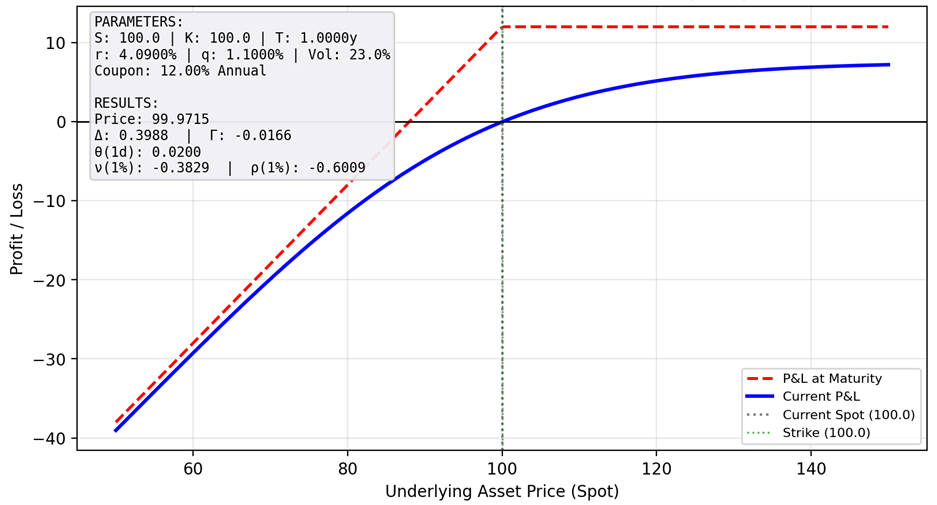
If the underlying finishes at or above the strike at maturity, the put expires worthless and the investor receives 100% of the notional back. If it finishes below the strike, the put is exercised against the investor, who receives the underlying’s value instead of the par value.
RC price = Bond + PV(Coupons) − Short Put value
99.9715 = 95.9925 + 11.5191 − 7.5401
Component prices (per 100 notional):
| Component | Price |
| Zero-coupon bond | 95.9925 |
| PV of guaranteed coupons (unless default of the issuer) | 11.5191 |
| Short put (conversion strike) | -7.5401 |
| Total reverse convertible price | 99.9715 |
Source: Evolids Finance
Greeks for the structured product:
| Greek | Value |
| Delta | 0.3988 |
| Gamma | -0.0166 |
| Theta (1 day) | 0.02 |
| Vega (1 volatility percentage up) | -0.3829 |
| Rho (1 rate percentage up) | -0.6009 |
Source: Evolids Finance
Greeks for the short put only:
All of the product's Delta, Gamma and Vega risks stem exclusively from this short put leg. However, the interest rate sensitivity (Rho) behaves entirely differently when assembling the full product. While the short put on its own has a positive Rho (because higher interest rates increase the forward price of the underlying, which decreases the put's value), the straight bond component has a highly negative Rho (bond prices fall when rates rise).
Because the bond accounts for the vast majority of the product's capital weight, its negative Rho completely overpowers the put's positive Rho. Therefore, adding the bond to the equation pulls the total product's Rho deeply into negative territory.
| Greek | Value |
| Delta | 0.3988 |
| Gamma | -0.0166 |
| Theta (1 day) | 0.008 |
| Vega (1 volatility percentage up) | -0.3829 |
| Rho (1 rate percentage up) | 0.4742 |
Source: Evolids Finance
Here the at expiration graph of the reverse convertible:
Reverse convertible – profit & loss (P&L)
Sour
Source: Evolids Finance
Image: Tookpiik/Adobe Stock
| This article is based on data and analysis provided by the SRP Greeks product. Find out more about SRP Greeks here |
Disclaimer: This content is not intended as a solicitation or an offer; it is provided solely for informational purposes to professional investors. The information presented herein has been prepared with great