
Sales for structured products linked to commodities in Asia dwarf those seen in Americas and Emea.
Asia Pacific drives global commodity demand
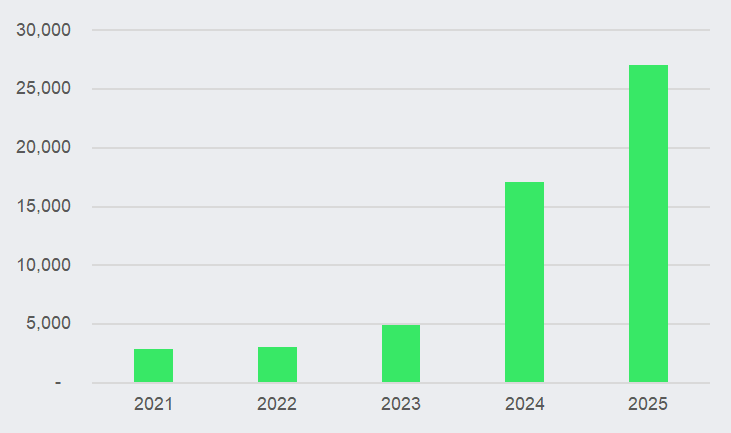
Asia Pacific remained the clear leader for commodity-linked structured products in 2025, accounting for the overwhelming majority of global sales. Annual issuance climbed steadily over the past five years, with sales at US$27 billion, reaching a new peak in 2025 and significantly outperforming the broader structured products market.
Asia Pacific: commodity-linked sales by year (US$m)
Source: SRP
The region's issuer rankings underline the concentration of activity. Ping An Group captured a 42% market share, followed by Hua Xia Bank (24%), China Merchants Bank (20%) and Bank of China (12%). Together, these four institutions controlled virtually the entire market.
The dominance of Chinese issuers reflects strong domestic demand for products linked to precious metals and commodity-related investment themes. Commodity-linked structures have become a useful diversification tool for investors looking to complement traditional equity and fixed income holdings, particularly during periods of heightened market uncertainty.
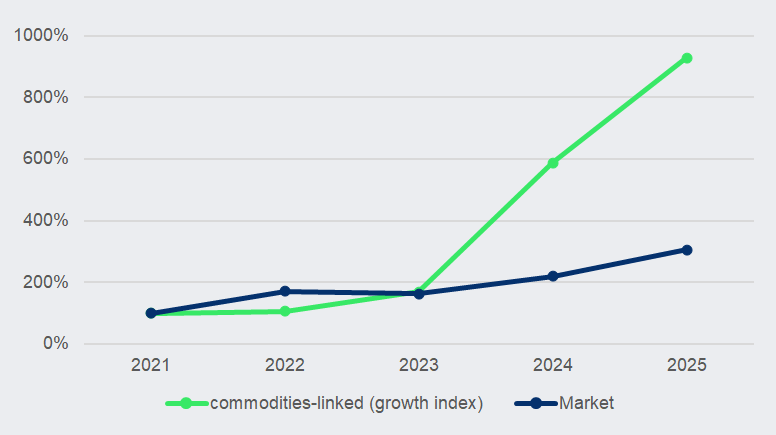
Asia Pacific: commodity-linked vs total market sales growth
Source: SRP
The region's growth trajectory has been particularly notable. The commodities growth index expanded at a significantly faster pace than the overall market between 2021 and 2025, highlighting increased investor appetite for alternative asset exposures.
Americas selective in commodity exposure
The Americas represented the second-largest region for commodity-linked structured products in 2025, although volumes remained well below those seen in Asia Pacific. Issuance continued to increase over the five-year period, supported by demand for commodity exposure as part of diversified investment portfolios.
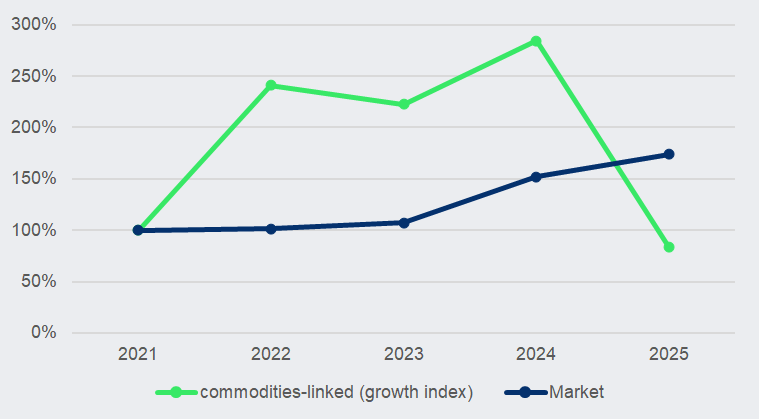
Americas: commodity-linked vs total market sales growth
Source: SRP
Unlike Asia, where local institutions dominate, the Americas market was led by a mix of global investment banks. J.P. Morgan captured 38% market share in 2025, ahead of UBS (24%), BNP Paribas (15%) and Morgan Stanley (9%). Citi, Goldman Sachs, BMO Financial, and Bank of America also maintained meaningful market positions.
Growth in the region exceeded that of the broader structured products market over much of the review period, although the pace was less dramatic than in Asia Pacific and Emea. Across all regions, one of the key themes was the increasing acceptance of commodities as a complementary allocation within structured products portfolios. While equities continued to dominate the overall market, commodities offered investors exposure to inflation-sensitive assets and diversification benefits that were difficult to achieve through traditional stock and bond allocations alone.
The global issuer rankings also highlight a growing divide between regions. Asia Pacific is driven almost entirely by domestic Chinese institutions, while Europe and the Americas remain dominated by international investment banks. This reflects differing investor preferences, distribution models and regulatory environments.
Emea remains a specialist market
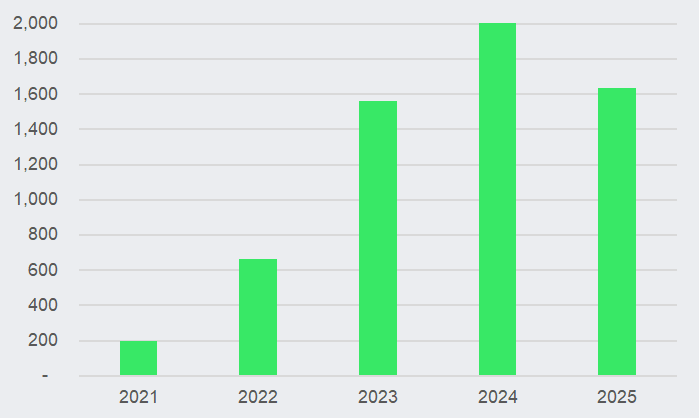
In contrast, commodity-linked issuance in Europe, the Middle East and Africa (Emea) remained comparatively modest. Annual sales reached approximately US$1.6 billion in 2025, down from US$2 billion in 2024, only a small fraction of global volumes. However, the asset class experienced strong growth over the review period.
Emea: commodity-linked sales by year (US$m)
Source: SRP
The Emea commodities growth index rose substantially faster than overall market growth, indicating increasing investor interest despite the relatively small size of the market.
BNP Paribas was the leading issuer in the region, accounting for 41% of sales. UBS ranked second with a 19% market share, followed by UniCredit (13%) and Leonteq (11%). Deutsche Bank, Société Générale, Goldman Sachs and Raiffeisen Switzerland also maintained a presence in the market.
The concentration among a small group of issuers suggests commodity-linked products remain a specialist offering within Emea, often used to provide targeted exposure to precious metals or broader commodity baskets rather than serving as a mainstream investment allocation.
Image: Igor_Tichonow/Adobe Stock
| This article first appeared in the SRP Asset Class Report 2026, which is available for download here. |
Do you have a confidential story, tip or comment you’d like to share? Contact Us | SRP (structuredretailproducts.com).