 copy.png)
The French bank eyes innovative payoffs, single-stock and thematic structures and digital channels as structured product demand broadens across the region.
Crédit Agricole CIB (Cacib) is betting on product innovation and technology to capture opportunities in an increasingly competitive Asia Pacific structured products market, as record issuance and sales volumes point to strong investor demand.
Most of our competitors regularly show thematic ideas, but we focused more on innovation at the payout level, which our clients appreciate - Rishad Schaefer
The bank was recognised at the SRP Apac Awards, winning Best House Asian Equities, Best House South Korea - Hedge Provider and Deal of the Year.
Beyond thematics
Cacib attributes its award success to a focus on payoff innovation rather than simply replicating the thematic ideas increasingly common across the market.
“We have a cross-asset distribution sales team showcasing innovations and bespoke solutions on both FICC and EQD structured products,” Rishad Schaefer (pictured), head of equity sales and structuring for Asia at Cacib, told SRP.
While the market has become increasingly commoditised, Schaefer said it has deliberately focused on developing differentiated payout structures.
“Most of our competitors regularly show thematic ideas, but we focused more on innovation at the payout level, which our clients appreciate,” he said.
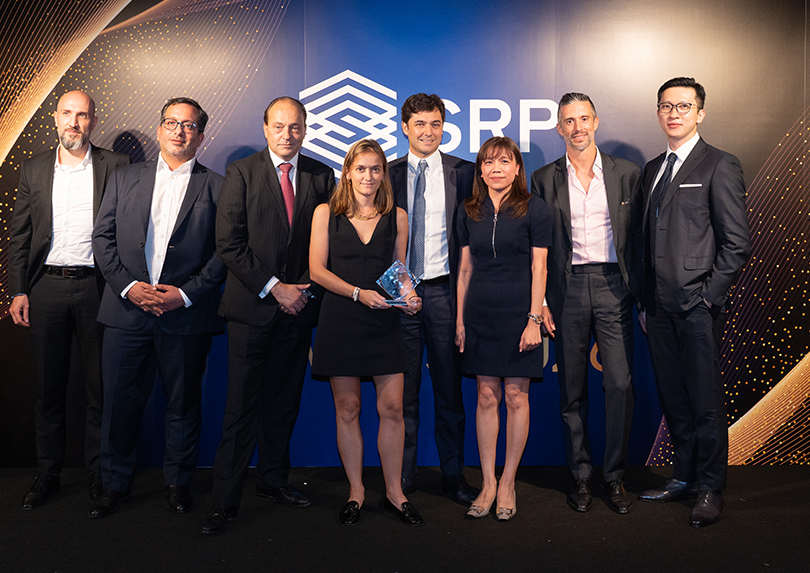
The Cacib team at the SRP Asia Pacific 2026 Awards in Hong Kong on 24 June with Rishad Schaefer fourth from right.
This approach has also been reflected in the bank’s recent awards track record, including SRP’s Most Innovative House award in 2024 and 2025, followed by Deal of the Year in 2026.
The winning transaction was a spot dispersion trade based on a performance engine introduced to the market in 2025.
“The investor wanted diversification through an alternative strategy with close to zero correlation to bonds or cash equities,” said Schaefer, describing its approach as tactical, both in terms of product development and client coverage. “We offer differentiating solutions, and we don’t aim to cover all clients but rather better serve our strategic partners."
Next frontier
Private banks remain the primary distribution channel for structured products and are expected to retain that position, but the distribution model itself is changing.
The traditional relationship-manager model is coming under pressure from digital tools, while banks investing in platform capabilities are expected to capture a greater share of structured product flows. At the same time, relationship managers are increasingly looking to join or establish smaller external asset managers.
Cacib sees an even larger opportunity in Southeast Asia’s mass-affluent segment, broadly defined as investors with between US$100,000 and US$1 million in investable assets.
The segment is expanding rapidly across Indonesia, Vietnam, Thailand and the Philippines but remains largely underserved by sophisticated structured payoffs.
The challenge is that distribution infrastructure remains relatively thin, financial literacy varies and regulatory frameworks for retail structured products remain immature across much of the region.
The bank expects digital wealth platforms and bancassurance channels to provide the most effective route into the segment, with simpler products likely to lead the way.
Capital-protected structures, yield-enhancement notes with clear payoff diagrams and thematic participation notes could prove more suitable than complex multi-barrier autocallables.
The development of the FIA and IUL markets is another area watched closely. Following early developments in Singapore and a less successful experience in Hong Kong, structured product desks are awaiting greater clarity on the framework Taiwanese regulators will establish for the launch of these activities next year, according to Schaefer.
Market disruption
Structured product distribution remains closely linked to investor sentiment and equity market performance, with US stocks continuing to exert significant influence over Asian markets.
The S&P 500 rose 25% in 2024 and 16% in 2025, with a further 13% gain year-to-date in 2026, according to Schaefer. Strong performance in the Korean market has provided an additional catalyst.
Two major disruptions – the US tariff announcements in 2025 and the conflict in the Middle East this year – have also produced short-lived periods of volatility followed by rapid recoveries.
“These events create ‘buy-the-dip’ opportunities and bring an extra boost to volumes,” Schaefer said.
“Both 2025 and 2026 so far have been record years for both issuers and distributors.”
AI and semiconductors
Autocallables and reverse convertibles continue to dominate structured products, but Cacib is seeing greater demand for volatility-linked and multi-asset payoffs among sophisticated private banking clients in Singapore and Hong Kong.
Structures linked to credit, rates and commodities are also gaining market share, while AI and semiconductor themes remain particularly prominent given the composition of Asian equity markets and investor appetite for concentrated thematic exposure.
Shorter-dated and more liquid structures have also become increasingly popular, reflecting demand for flexibility and lessons learned during the volatility episodes of 2020–2022.
“Digitalisation is reshaping the market at the same time,” said Schaefer. “Third-party pricing and execution platforms have compressed issuer margins and reduced the time between structuring and distribution from days to hours.”
According to Schaefer, this has helped increase trade volumes while reducing average notional sizes and changing the relationship between issuers and relationship managers.
“AI-driven structuring and pricing tools are now being adopted by both sell-side desks and private banks, enabling more personalised payoff design and real-time scenario analysis,” said Schaefer. “Digital wealth platforms are also beginning to incorporate structured product wrappers, potentially extending access to mass-affluent investors previously excluded from the market.”
Reshaping the product mix
ESG-linked payoffs remain relatively small compared with Europe, partly because less-developed ESG data infrastructure across Asia makes credible structuring more difficult.
Green and sustainability-linked structured notes, however, have found a more receptive audience.
Regulatory initiatives are helping to drive this market, with Singapore’s MAS taxonomy, Hong Kong’s Green Classification Framework and China’s green finance standards creating incentives for greater product development.
“Cross-border activity is another important structural trend," said Schaefer. “Greater China connectivity remains a key long-term theme, particularly as the range of structured products accessible to mainland Chinese investors through Hong Kong expands.
“Southeast Asia is also emerging as a new distribution frontier, particularly Thailand and Indonesia, where retail investors are increasingly being served by local banks and regional private banks.”
India is another market to watch. GIFT City is positioning itself as an offshore hub for structured product issuance and distribution, according to Schaefer.
Strategic priorities
At firm level, Schaefer highlights the work undertaken over the past three years to automate its pricing and execution platform.
“The objective has been to establish an optimised front-to-back process and robust lifecycle management without compromising the bank’s focus on innovation and product development,” he said, adding that the technology push comes as demand shifts away from some traditional index underlyings.
Historically, markets such as Korea and Japan had significant exposure to index-linked structured products. Regulatory interventions in Japan in 2022 and Korea in 2023, following losses suffered by retail investors in H-shares-linked products, have materially reduced appetite for these benchmark indices, particularly China equity.
In contrast, single-stock underlyings are gaining ground, particularly in technology and semiconductors. TSMC, Nvidia, Samsung and ASML are among the names attracting interest, alongside curated thematic baskets. Their higher implied volatility can translate into higher coupons, supporting demand in a yield-seeking environment.
Cacib sees a growing tension between regulatory and retail pressure for simpler products and demand from family offices and institutional investors for increasingly bespoke structures.
“The market is effectively bifurcating to serve both,” Schaefer said. “The issuers and distributors who can operate credibly in both segments will have a structural advantage.”
Positive outlook
The bank remains confident about the market outlook despite elevated equity valuations and geopolitical risks.
Higher interest rates provide greater flexibility in product construction, while increasing investor familiarity with structured products is supporting demand for predefined outcomes.
“Fixed coupon notes, in particular, have become increasingly mainstream across Asian markets,” said Schaefer.
The biggest threat to sustainable growth, according to Schaefer, is not necessarily market volatility but distribution friction and reputational risk.
Previous mis-selling episodes have prompted regulatory intervention in Japan and Korea, highlighting the importance of transparency, disclosure and responsible distribution.
“Our responsibility is to ensure transparency, proper disclosure and responsible distribution,” Schaefer concluded. “Managing well that dimension, while working hand in hand with regulators is critical for sustainable growth.”
| Click the link to view all the winners of the SRP Asia Pacific 2026 Awards |
Do you have a confidential story, tip or comment you’d like to share? Contact Us | SRP (structuredretailproducts.com)