
In the second and final part of our review of FX-linked structured products, we take a closer look at the difference between the various regions.
Asia Pacific remained the undisputed centre of gravity for FX-linked structured products in 2025, accounting for the overwhelming majority of global issuance volumes. Regional sales approached US$800 billion, dwarfing activity in both Emea and the Americas.
The dominance of Asia reflects the longstanding popularity of dual-currency investments and FX-linked wealth management products in mainland China and other regional markets. Currency strategies are often embedded into savings products, structured deposits and wealth management solutions, making FX exposure far more commonplace than in Europe or North America.
Apac: new sales (US$m)
Source: SRP
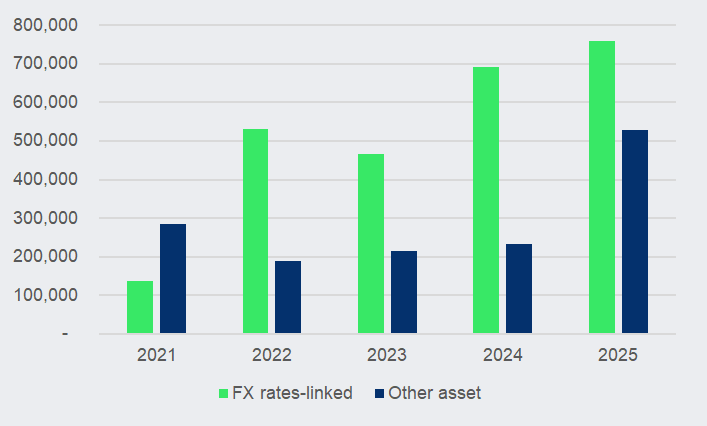
Chinese institutions dominated the regional rankings. Ping An Group captured 42% of Apac issuance in 2025, followed by Hua Xia Bank (24%), China Merchants Bank (20%) and Bank of China (12%). Collectively, these four institutions represented almost the entire regional market.
The continued growth of FX-linked issuance in Asia has been underpinned by increased investor engagement with currency markets amid ongoing geopolitical uncertainty, divergent monetary policy paths and persistent volatility in major currency pairs.
Products linked to USD/CNY, USD/HKD and other regional currency combinations continue to feature prominently across Chinese wealth management channels.
Apac: FX-linked vs total market sales growth
Source: SRP
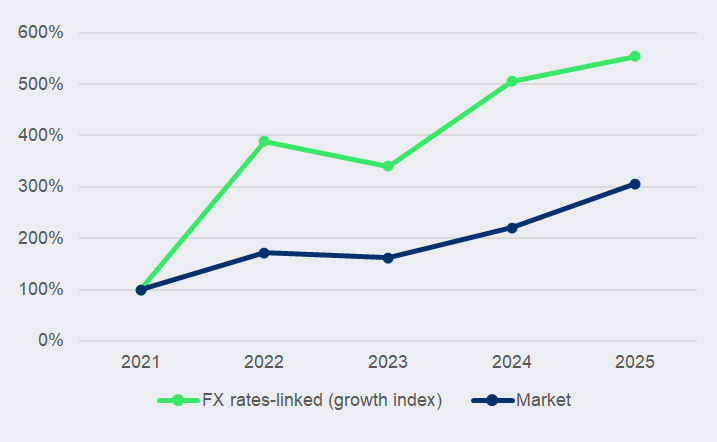
Despite its scale, FX-linked market share in Asia has gradually moderated as equities regained momentum during 2025. Nevertheless, the asset class remains a core component of many retail investment portfolios due to its ability to generate enhanced yields without requiring outright equity exposure.
The growth profile also remains impressive. The asset class has expanded significantly faster than the broader structured products market over the past five years, suggesting that investor appetite for currency-based strategies remains robust even as other asset classes attract increased attention.
The concentration of issuance among a handful of Chinese institutions further highlights the importance of domestic wealth management distribution networks in driving volumes.
Unlike equities, where issuance is dispersed across multiple regions and issuers, FX-linked activity remains highly regionalised, with Asia acting as the principal engine of growth.
Europe and Americas remain niche markets
While Asia dominates global FX-linked issuance, Europe, the Middle East and Africa (Emea) and the Americas continue to play a secondary role.
In Emea, annual sales remained below US$3 billion in 2025, making foreign exchange one of the smallest underlying asset classes in the region.
Nevertheless, growth has been significant over the past five years, with issuance increasing at a much faster pace than the broader structured products market.
Emea: new sales (US$m)
Source: SRP
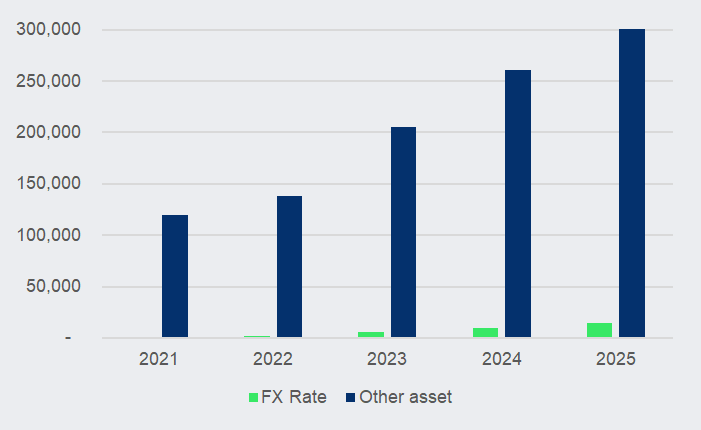
The regional issuer rankings were led by BNP Paribas, which captured 41% market share. UBS followed with 19%, while UniCredit and Leonteq claimed 13% and 11%, respectively.
The remaining market was fragmented among a small number of European private banking and investment banking providers.
Emea: FX-linked vs total market sales growth
Source: SRP
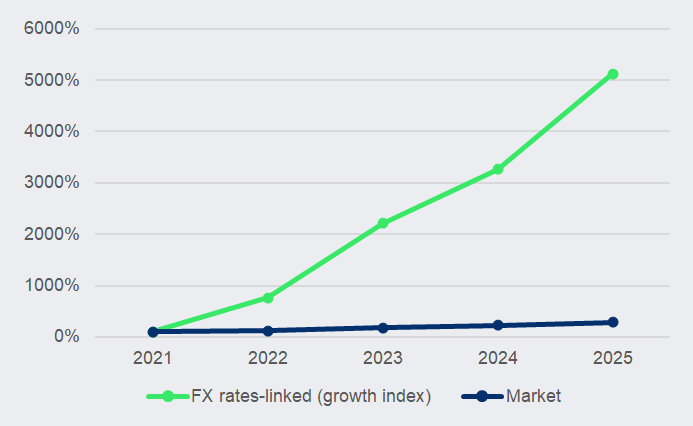
In Europe, FX-linked products are generally used more selectively than in Asia. Investors often view currency exposure as a complement to broader portfolio strategies rather than a standalone investment theme.
Products are frequently deployed to monetise volatility, express views on interest-rate differentials or hedge international investment exposures.
The Americas generated substantially higher issuance volumes than Emea, with annual sales approaching US$200 billion in 2025. However, the asset class remains overshadowed by equities, which continue to dominate structured product activity across the region.
Americas: new sales (US$m)
Source: SRP
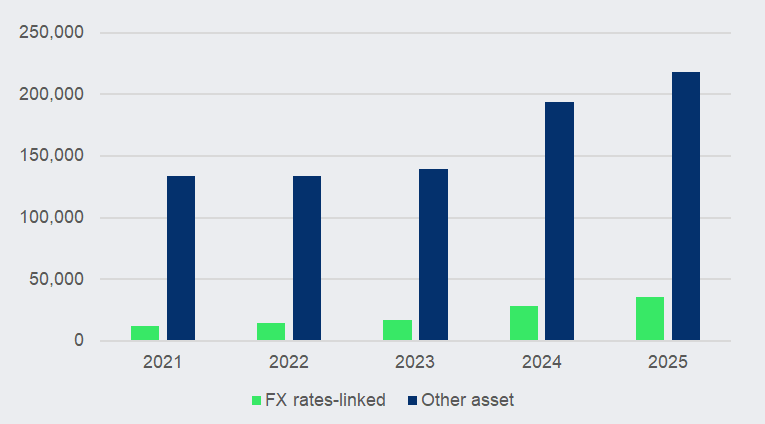
J.P. Morgan led the Americas market with a 38% share of issuance, followed by UBS (24%), BNP Paribas (15%) and Morgan Stanley (9%). Citi and Goldman Sachs also maintained meaningful positions.
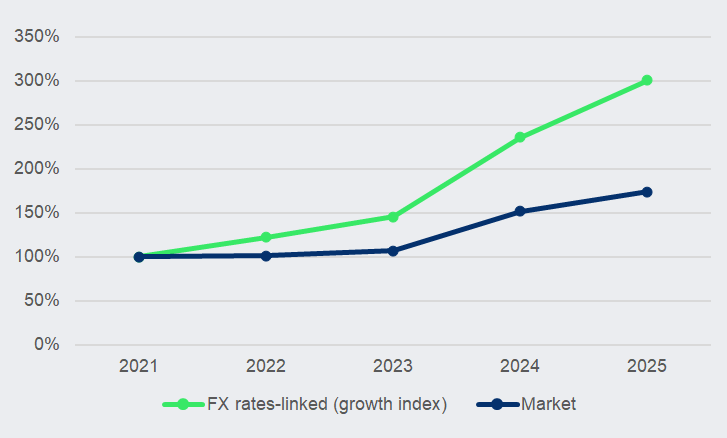
The regional growth profile has been steady rather than spectacular, reflecting the mature nature of North American structured products markets. Investors continue to favour equity-linked and income-generating solutions, limiting the role of FX strategies despite favourable trading conditions in currency markets.
Americas: FX-linked vs total market sales growth
Source: SRP
Globally, the FX-linked market remains characterised by two distinct realities. In Asia, currency-linked products represent a mainstream investment solution distributed at scale through retail banking networks. In Europe and North America, they occupy a more specialist role aimed at investors seeking diversification, yield enhancement or targeted macroeconomic exposure.
As a result, FX remains one of the largest underlying asset classes in structured products, even if its global footprint is increasingly shaped by developments in Asia rather than Western markets.
Image: Zignalstudio/Adobe Stock
| This article was originally published in the SRP Asset Class Report 2026, which is available for download here |
Do you have a confidential story, tip or comment you’d like to share? Contact Us | SRP (structuredretailproducts.com)