Outcome ETFs are reshaping the delivery of defined protection, income and growth strategies.
The growing outcome-oriented ETFs are expanding structured notes and options-based strategies into a scalable and transparent ETF wrapper, primarily focusing on capital protection, income generation and growth.
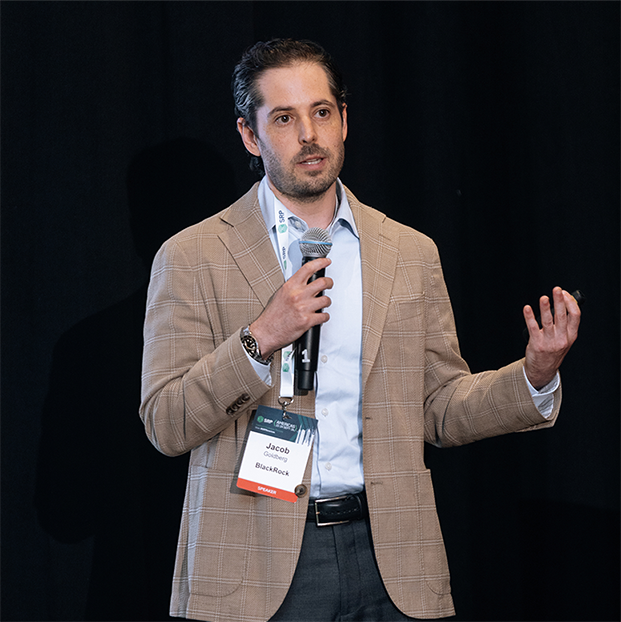
Jacob Goldberg (pictured), director, outcome product strategist at BlackRock, delivered a training module during the SRP Americas 2026 Masterclass focused on the increasing footprint of outcome ETFs.
Goldberg focused on the US$300 billion outcome ETF market, highlighting the market has grown from a small category in 2019 and is expected to reach US$650 billion by 2030.
“A big part of this growth is really coming from financial advisors. We also see a bit on the income side, a lot of retail attention as well,” he said.
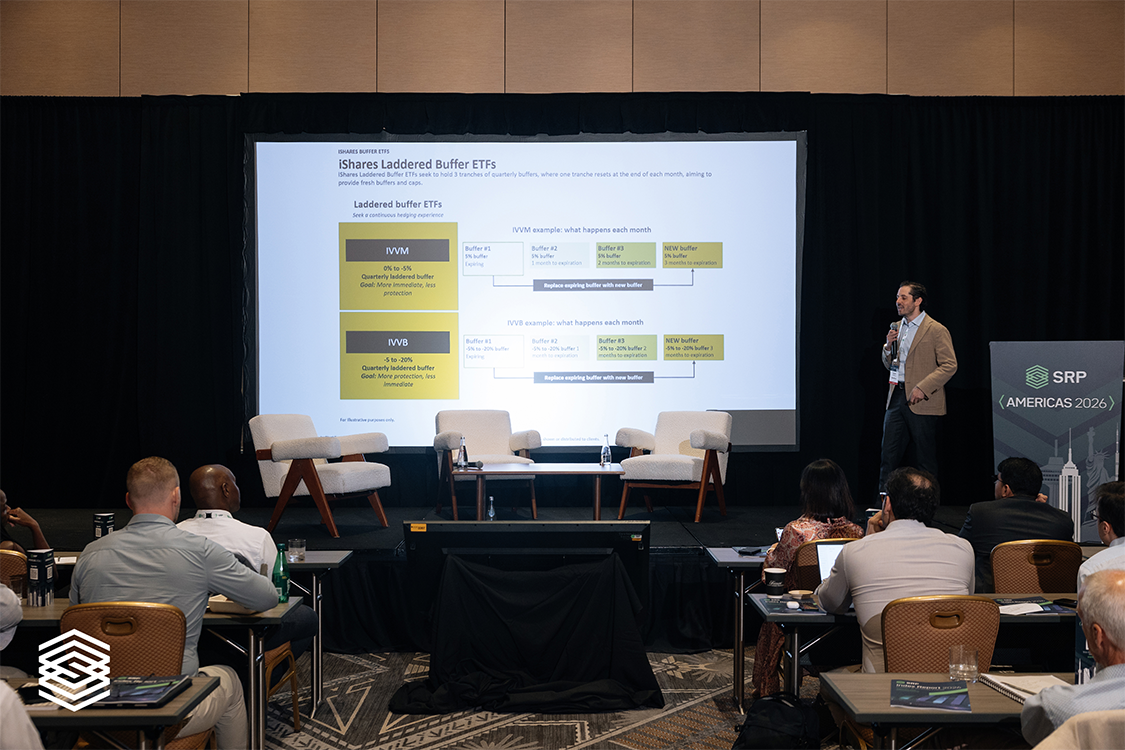
Jacob Goldberg adressing the audience at SRP Americas 2026
The role the financial advisers play in driving the growth includes helping clients stay invested, shifting cash from the sidelines, managing equity tail risk and sourcing income as equity yields decline, according to Goldberg.
The mechanics behind
Goldberg introduced the characteristics of buffer ETFs which are equipped with defined downside protection and a capped upside over a stated outcome period - one year mostly. Examples include 100% protection with caps around six to eight percent, or a 10% buffer with caps around 16% to 18%.
FLEX (Flexible Exchange) options are commonly utilised for buffer ETF, which provides customised strikes and expiries as well as reduces counterparty risk.
The majority of the industry players use FLEX options solely for underlying exposure, while BlackRock has its own S&P 500 ETF, IVV, which serves as the building block of all its buffer ETFs, he said.
“We found this to be a very capital-efficient way to get that underlying exposure. It's much easier for counterparties like market makers to hedge against IVV compared to a zero strike price call option,” said Goldberg.
Investors shall understand that the defined outcome experience requires holding through the full outcome period, while multiple tickers support staggered reset dates, he noted.

Jacob Goldberg
Unlike structured notes that come to maturity, buffer ETFs will experience a reset that options are rolled and the fund receives a fresh buffer and cap without a capital-gains event from the in-kind process.
Laddered ETFs hold multiple staggered buffer tranches, with monthly or quarterly resets to provide more continuous protection and reduce reliance on a single entry date.
“You give up some of that very clear, defined buffer, defined cap experience, but what you get instead is ultimately more consistency across your buffer business, more consistent risk management, and more continuous downside protection,” he said.
Income leads
According to Goldberg, the income side has been the fastest growing space inside “the outcome ETF revolution”, with about US$200 billion in assets.
Buy-write income funds follow a buy, write, roll and distribute operating cycle. Strategies vary by underlying exposure, option tenor, overwrite percentage, management styles and distribution policy, he shared.

“What we tend to see is really two distinct categories. One is more high income focused. We're typically seeing the ETFs right on 100% of the fund...to kind of maximise the income component, and then you see really the more popular side is what we call more growth in income. It's really trying to balance capital appreciation and income. So call funds that target call at that seven to nine percent range without having to give away 100% of their upside is really that blend that we see becoming,” he said.
At the end of the session, Goldberg concluded that ETFs and structured products complement each other, although the distinction between the two is becoming less clear as investors find more ways to combine and structure them.