The bank recorded US$1.79bn in aggregated notional across more than 83,000 transactions and products in the awards data, with vanilla call and call-spread structures accounting for the largest share.
Brazil's structured products market continued to expand in 2025, although higher interest rates made investors more selective about the returns offered by structured investments. The outstanding stock of Certificados de Operações Estruturadas (COEs) registered with B3 reached a record R$100.25bn in February 2026, up 12% from R$89.1bn a year earlier. The exchange reported 426,981 contracts outstanding at the end of the month. COEs combine fixed-income and variable-income components to provide exposure to different underlying assets and predefined investment outcomes.
In Brazil we cover the full value chain, from product design to the relationship with the end investor - Antonio Cesar Polezzi
Santander Brasil's structured products activity spans a range of underlying assets and payoff structures. Its public structured products offering includes strategies such as fences, collars, knock-out structures, covered calls and call ratios, while its COE business provides access to investment outcomes linked to different market scenarios.
The data submitted for this year's SRP Americas Awards records US$1.79bn in aggregated notional across 83,356 Santander transactions and products. Vanilla call structures represented US$1.26bn, while call spreads accounted for a further US$434m. Together, the two categories made up approximately 94.5% of the total notional. Digital puts contributed US$52.1m, digital calls US$43.6m and straddles US$3.6m.
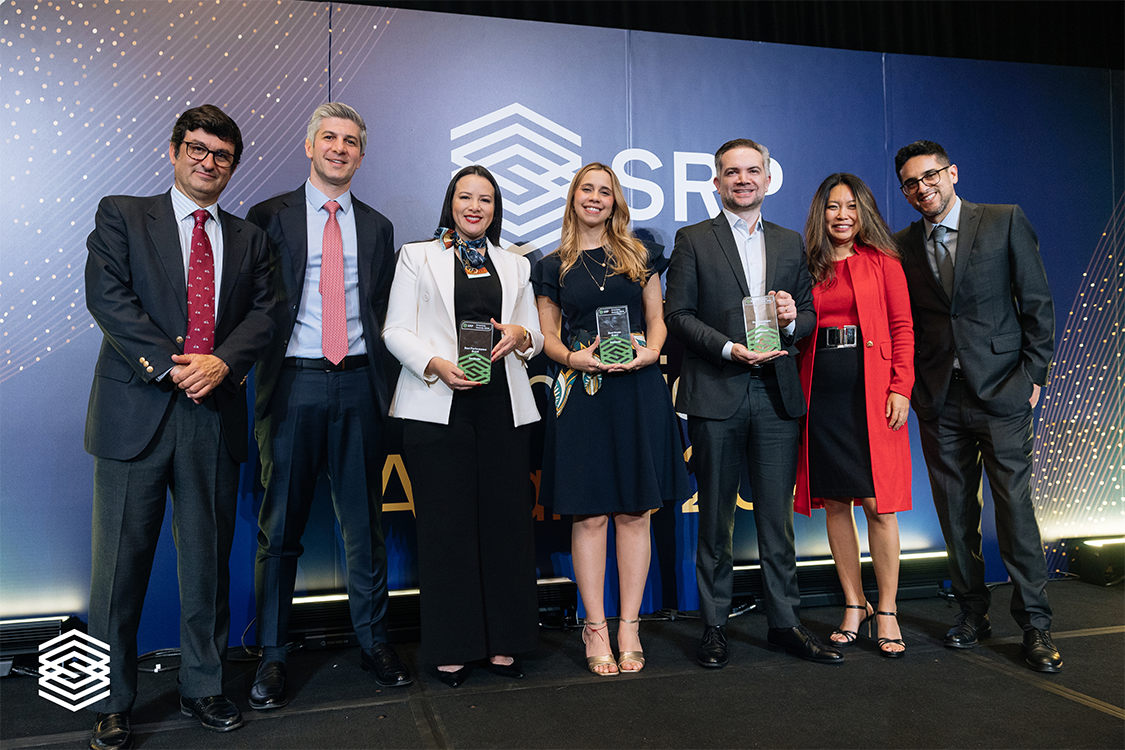
The Santander Brasil team at the SRP Americas 2026 Awards in Scottsdale, Arizona on 23 September with Antonio Cesar Polezzi second from left.
The figures point to a business concentrated in participation-based structures, although Santander's offering also covers products linked to interest rates, inflation, currencies, Brazilian and international equities and gold.
For Antonio Cesar Polezzi, executive director and head of fixed income sales at Santander Brasil, the market's development has been shaped by the competition between structured products and conventional fixed income, as well as the need to explain the different risks embedded in individual structures.
"I would characterise 2025 as a year of growing demand and greater selectivity. Compared with 2024, higher interest rates raised the bar for structured products, with investors seeking diversification while expecting a competitive proposition relative to conventional fixed income," he said.
The year also brought losses and early terminations in some credit-linked structures, which Polezzi said affected investor confidence. He believes some investors still struggle to distinguish products carrying additional exposure to the credit risk of a reference entity from traditional capital-protected structures, where the principal credit exposure is to the issuing bank.
"Santander did not distribute the credit-linked structures involved in these events," he said. "The challenge is to make those differences clear and prevent the risks of specific products from being attributed to the entire product category."
Structuring and distribution
Polezzi attributes Santander's position in the market to a business model that brings product design and distribution together. The bank covers the process from structuring through to the end-investor relationship, combining its international market access with local distribution and client knowledge.
"In Brazil we cover the full value chain, from product design to the relationship with the end investor," he said. "This allows us to combine a global bank's structuring expertise and market access with the local knowledge and close client relationships of a domestic distributor."
The model also allows the product teams to work more closely with distribution channels and identify investor requirements. Polezzi said the objective was to link product design with portfolio construction and ongoing client support rather than simply offering a selection of individual products.
The range of underlying assets has broadened accordingly. Santander offers solutions linked to interest rates, inflation, currencies, domestic and international equities and gold. Polezzi also highlighted structures that combine nominal capital protection with a contractually guaranteed minimum return at maturity and participation in the performance of an underlying asset.
Such products offer a minimum return alongside the potential for additional gains, although the final outcome depends on the terms of the individual structure.
The interest rate environment has been an important factor in determining how these payoffs are designed. Higher rates increase the return investors can obtain from conventional fixed income, raising the hurdle for structured products. At the same time, they can reduce the present cost of repaying principal at maturity, potentially leaving more room in a capital-protected structure's option budget to fund participation in an underlying asset.
"We use that flexibility to balance minimum returns and upside participation, calibrating tenor and any caps to implied volatility," Polezzi said. "Getting the underlying investment view right is not enough: option pricing must support a competitive payoff against an attractive fixed-income alternative."
Retail access
Santander distributes COEs to retail investors in Brazil, with minimum investments equivalent to around US$1,000, according to Polezzi. The bank also distributes credit-linked notes (CLNs) through its private banking business, providing a separate route for clients seeking exposure to reference-entity credit risk.
The distribution model combines digital access with support from relationship managers and investment advisers. Polezzi said the products offered through each channel are tailored to the profile and requirements of the relevant investor segment.
He believes that expanding access needs to be accompanied by a clearer understanding of the risks and potential outcomes. Advisers should compare a structured product with direct exposure to its underlying asset and with CDI, Brazil's interbank benchmark, while explaining the sources of return and the distinction between market risk, issuer risk and any additional credit exposure to a reference entity.
"Education must turn an understanding of the payoff into an informed allocation decision," he said. "The goal is not simply to explain how a product works, but why it makes sense in a particular portfolio, including under adverse scenarios."
This distinction has become particularly relevant following the problems experienced by some credit-linked products. COEs can be issued in different forms, including nominal-protected and nominal-at-risk structures, and the risks depend on the specific terms of each product.
Regional opportunities
Brazil is a key part of Santander's structured products platform in Latin America, alongside Mexico. Polezzi said the bank can share structuring capabilities and expertise across markets while adapting products to local currencies, investor profiles and market conditions.
"The main opportunities lie in deepening relationships with our clients in those markets and enabling greater international diversification," he said.
Over the next 12 months, he expects growth to come from broader access, more tailored solutions and international diversification. Interest rates will continue to influence the strategies investors choose, but he also highlighted the importance of technology, advice and transparency around risk.
"Across Brazil and Latin America, combining technology, high-quality advice and transparency around risk will be essential to translate investor interest into sustainable growth and lasting client trust," he said.
Image: Casa da Photo/Adobe Stock
| Santander Brasil was recognised in three categories at this year's SRP Americas Awards 2026: Best House, Brazil; Best Distributor, Brazil; and Best Performance, Brazil. |