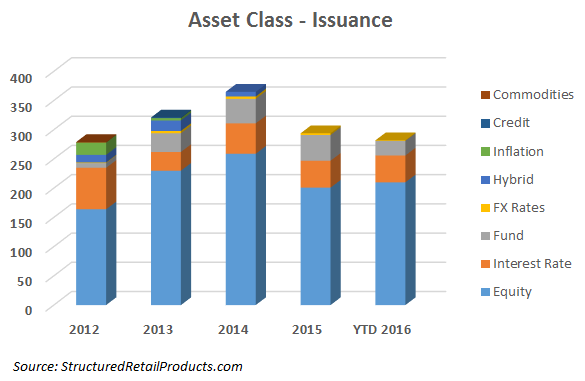
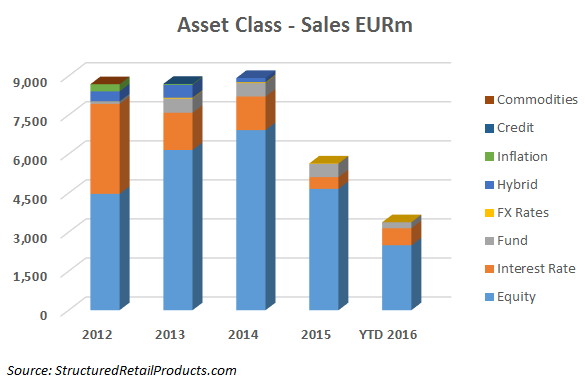
Equities, seen in 18 eighteen structured products, dominated the Belgian market in September - as they have done for a number of years now - followed by interest rates and products linked to managed funds.
Whereas the majority of Belgian providers opted for a single equity index to underlie their structured products, KBC stuck to a basket of 20 or 30 stocks for its funds and unit-linked (Class 23) products - with the exception of Perspective Europe Airbag Bonus USD 2 which was linked to the Eurostoxx 50. At the same time, five products, from five different providers (Belfius, BNP Paribas Fortis, Deutsche Bank, ING Belgium and KBC), were linked to the constant maturity swap (CMS) rate while the two fund linked products were issued via Natixis and Deutsche.
Single indices and interest rates are the preferred solutions in the current market conditions, according to Annick Pierard, product management investments, ING Belgium. "We also notice that an index based approach is more straightforward than a basket of individual shares which sometimes can be considered as more complex. Retail clients can easily find information on these kinds of underlyings during the lifetime of the product," said Pierard.
VDK Spaarbank (VDK) became the first Belgian distributor to use the Ecofi SRI Europe PR Index as underlying for a structured product. The Flemish savings bank's Codeis Securities (LU) Ecofi SRI Switch Note 2025 participates 100% in the positive performance of the new index - a joint effort between French investment boutique Ecofi Investissements (index adviser) and Finvex (index sponsor) - subject to 2.5-years back end averaging.
The reason why the bank opted for the index is twofold, according to Thomas De Nil, coordinator investments at VDK. "On the one hand we look to indices with a good risk/return performance, and that is certainly the case with the Ecofi SRI index," said De Nil. "The second point is that at VDK, sustainability and socially responsible investing (SRI) are important themes, and this index fits perfectly in our investment approach."
Of the 25 structured products added to the SRP Belgium database in September, 14 protected 100% of the nominal invested; seven offered 90% capital protection; while the remaining four put full capital at risk. The latter included Belfius Light Reverse Private Notes, which uses the reverse convertible payoff and therefore falls outside the scope of the Financial Services and Markets Authority (FSMA) moratorium on the distribution of particularly complex structured products, is only available to those investors with movable assets at Belfius of more than €500,000.
This month's 100% capital protected products had an average tenure of 8.2-years. The longest duration was offered by Crelan's Credit Suisse (CH) Callable Global Demography 2026 with a term of just over 10 years.
"Full capital protection and an upside linked to (equity) markets for euro-denominated products requires to work with extra-long maturities," said Pierard. "Retail investors need to consider putting part of their capital at risk in order to find a balance between risk and return. Some clients understand the risk and are ready to take it and some prefer not to do so."
Three products were wrapped as unit-linked life insurance, also known as Class 23. The FSMA made a number of recommendations in September for improved reporting of unit-linked insurance products following an investigation into the insurance sector which had identified a number of shortcomings and points of concern.
Pursuant to Article 73 of the Royal Decree on life insurance (November 14, 2003), Belgian and foreign insurance companies must prepare an annual and a half-yearly report for each Class 23 investment fund sold via an insurance contract, however, according to the FSMA study certain insurance companies do not prepare any reports as required by the Royal Decree at all.
"The public usually doesn't know the Royal Decree which imposes the obligation to publish reports," said a spokesperson for the FSMA. "These reports only need to be made available at the registered office and there is no active publication requirement," said the spokesperson.
A speculation tax on capital gains realised on listed financial products sold within six months of their acquisition, which was implemented on January 1, 2016, has only generated €17m, instead of the budgeted €34m, Minister of Finance Johan Van Overtveldt of the New Flemish Alliance, told Parliament.
The tax applies, at the rate of 33%, to listed warrants, options and turbos on one or more predetermined listed shares and certificates of shares. ETFs and warrants, options and turbos linked to indices, commodities or currencies do not come under the new tax.
The impact of the tax on ING's sprinters has been limited, according to Alain Flas, global head of sales for products for private investors (PPI) at ING. "Belgium was already a small market for us in sprinters," said Flas. "We are for instance not listing them in Euronext Brussels but on Euronext Amsterdam or Paris. It is quite clear that speculation tax didn't help to increase flows in this type of products for Belgian retail investors."
The full Belgian market review for September will appear shortly.
Single indices and interest linked are the preferred solutions, ING Belgium
Belgian watchdog wants unit-linked reporting made public
Product snapshot: VDK wagers on new Finvex index with help from SocGen SPV