Swedbank maintained its position as market leader in the Swedish structured products market in the first nine months of 2016, followed by Nordea, while SEB recorded a reduction in sales of more than 70% over the period.
The number of structured products issued over the period was around 25% lower than in the first three quarters last year, while sales volumes, at SEK12,676m (€1,297m), were down approximately 50%. SRP reviews the data and the financial results of the top five Nordic structured products manufacturers.
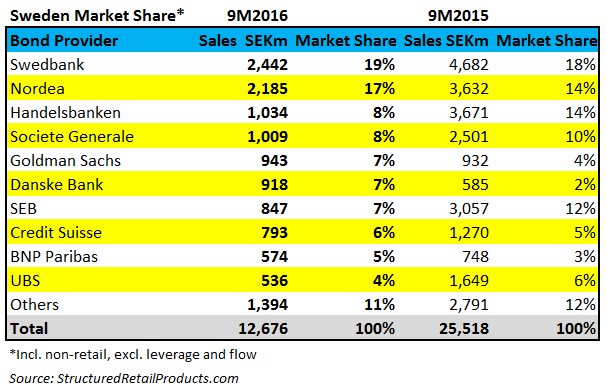
Swedbank, with a share of 19% of the Swedish structured product market, consolidated its position at the top of the bond provider table in Sweden in the first nine months of 2016, although sales were almost 50% down from the same period last year, according to SRP data. The bank issued 97 structured products worth SEK2,442m between January 1 and September 30, 2016, against 96 products with a sales volume of SEK4,682m in the same period last year.
Income from equity trading and structured products decreased, according to the bank's interim results for the period January - September 2016. As of September 30, 2016, Swedbank had SEK905,496m debt securities in issue of which SEK15,069m was invested in structured retail bonds, an 8% increase from SEK13,999 at the end of September last year. The market value of derivatives increased on both the asset and liability side, mainly due to large movements in interest rates and currencies, the bank said.
Nordea, the second most active bond provider, with a market share of 17%, issued 51 structured products with combined sales of SEK2,185m, in the first three quarters of 2016, against 92 products worth SEK 3,632m over the same period last year.
Nordea's five-year MEGA Kreditbevis Stena B370 with sales of SEK230.6m, was the best-selling product in the period. The credit linked note pays annual interest of 6% providing the underlying reference company Stena remains solvent.
Nordea issued approximately €4.7bn in long-term funding in the third quarter, excluding Danish covered bonds and subordinated notes, of which €3.2bn represented the issuance of Swedish and Norwegian covered bonds in domestic and international markets. A notable benchmark transaction in the quarter was a US$1bn dual tranche senior unsecured issuance out of Nordea Bank AB, split by a $750m three-year fixed rate and a $250m three-year floating rate note.
Handelsbanken, which achieved a market share of 8% over the period, launched 43 structured products in the first nine months of 2016, collecting sales of SEK1,034m, down both in issuance and sales from the 92 products worth SEK3,671m in the same period last year. Seventeen of the banks products this year were linked to a single index including the Ethical Europe Climate Care, Eurostoxx 50, OMX Stockholm 30 and the S&P Europe 350 Low Volatility.
Handelsbanken reported operating profit rose by 7% to SEK15,935m for the period January-September 2016 (9m2015: SEK14,942m) while return on equity for total operations rose to 14%. The common equity tier 1 ratio increased to 24% and the total capital ratio rose to 30.1%, according to the bank.
Danske Bank was the only Nordic bond provider which saw both its issuance and sales volumes increase. The bank issued 44 structured products with a combined sales volume of SEK918m between January and September 2016, compared to 29 products worth SEK585m issued in the same period last year. The majority of the bank's products (17) were linked to equities, followed by credit (16), fund (eight) and hybrids (three).
Danske Bank reported it made netting agreements with many of its counterparties concerning positive and negative market values of derivatives. The net exposure was DKK94bn (€12.6m), unchanged from the end of 2015, and it was mostly secured through collateral management agreements, according to the bank.
SEB launched 84 structured products worth SEK847m during the first nine months of 2016, down significantly both in issuance, but especially in sales, from the 107 products worth SEK3,057m seen in the prior year period.
The bank stated that net financial income increased by 30% to SEK5,018m, largely driven by customers who were active seeking risk management services throughout the nine months. Net financial income relating to the traditional life insurance operations in Sweden and Denmark also increased, by SEK464m year-on-year to SEK1,370m. This was counteracted by net negative valuation adjustments from counterparty risk (CVA) and own credit risk (DVA) in derivatives as well as issued structured bonds, amounting to SEK-442m. In 2015 this item was positive in the amount of SEK 482m, resulting in a negative change of SEK924m year-on-year, according to the bank.
Click the link to view the 9 month 2016 results for Swedbank, Nordea, Handelsbanken, Danske Bank and SEB.
Sweden Market Review - October 2016
Mangold keeps it local with Solactive Sweden index
Skandia targets modest risk takers with global trends index