The S&P 500 performed well in 2016, gaining more than 10%. The US benchmark started the year on 2012.6bps; reached its highest level (2271.7bps) on December 13, ended the year at 2238.8bps. However, the index was outpaced by a number of steel companies, including United States Steel, which, boosted by the result of the US presidential elections, ended 2016 on a high with a return of 332%.
In April, Vontobel issued a one-year Barrier Reverse Convertible linked to the United States Steel in Switzerland which offered a 23.5% (23.17% per annum), as long the stock did not trade below 50% of the initial price at any point, during the life of the product. If during the observation period, the underlying is at or below the barrier level and if the final level of the underlying is below the initial level, the product will return capital one-to-one with the negative performance of the underlying.
The barrier reverse convertible is a special variant of the classic reverse convertible. Investors in this type of structured products are giving up the potential upside exposure to the underlying asset in exchange for an enhanced coupon. Barrier reverse convertibles have four main factors that influence their pricing: volatility, interest rates, dividend yield of the underlying and volatility skew. With an historical annualised dividend of around 1%, according to the New York Stock Exchange (NYSE), and with the US 12-months Libor registering an average 1.2% during April, it was the volatility and its skew what enabled Vontobel to offer a 23.5% coupon with a barrier at 50%.
When the product struck, on April 5, 2016, the annualised historical volatility was 5.2 times higher than the S&P500 volatility. At the same time United States Steel reached 78% as an historical high while the VIX price decreased to 15.42% on the products strike date.
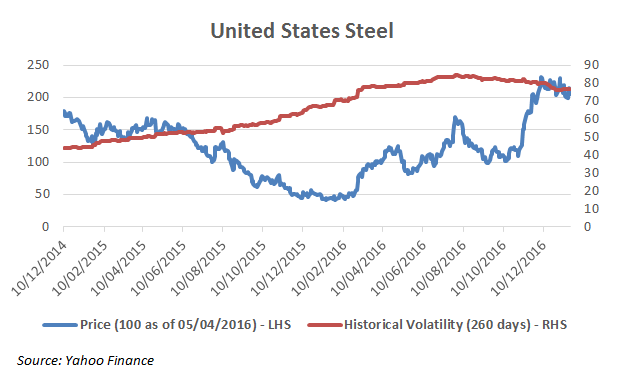
While assuming the risk to get a higher coupon, investors were able to fix a downside barrier, at 50%, due to the high volatility. The United States Steel share has gained more than 70% since Donald Trump's election, following the decline of the amount of steel imported from China and increase of the steel price, the investor can cash-in on a bet which payed off.
Related stories:
Not enough yield? There is always a switchable ESG solution
HSBC capitalises on quanto investing effect