
From Paris to Warsaw, industry experts discussed transparency, ESG hurdles and fintech challenges in a shifting EU regulatory landscapeat SRP Europe 2026 conference in London.
A meeting between the Council and the Parliamentary negotiators on the European Union’s Retail Investment Strategy (RIS) discussion was still underway, with an update expected in the next two weeks, according to Thomas Wulf, secretary general of the European Structured Investment Products Association (Eusipa), who kicked off the panel discussion.
There is an increasing discussion of pressure on the political side mounting - Thomas Wulf, Eusipa
“There is an increasing discussion of pressure on the political side mounting, and I think we're going to have some decision, one way or the other, the next two weeks,” Wulf said on 18 March.
In France, making the structured products distributed to retail investors is in focus, said Pauline Laurent, vice president at the French Structured Product Association (AFPDB), who mentioned its working group study on structured products published last month. The paper highlighted the need to distribute products with “clear, accurate and non-misleading” information provided to retail investors.
“It shows that we must continue our efforts – and that's what we have been doing indeed at the AFPDB – to promote the highest standards of our marketing documentation and to continue our efforts around the pedagogy,” she said.
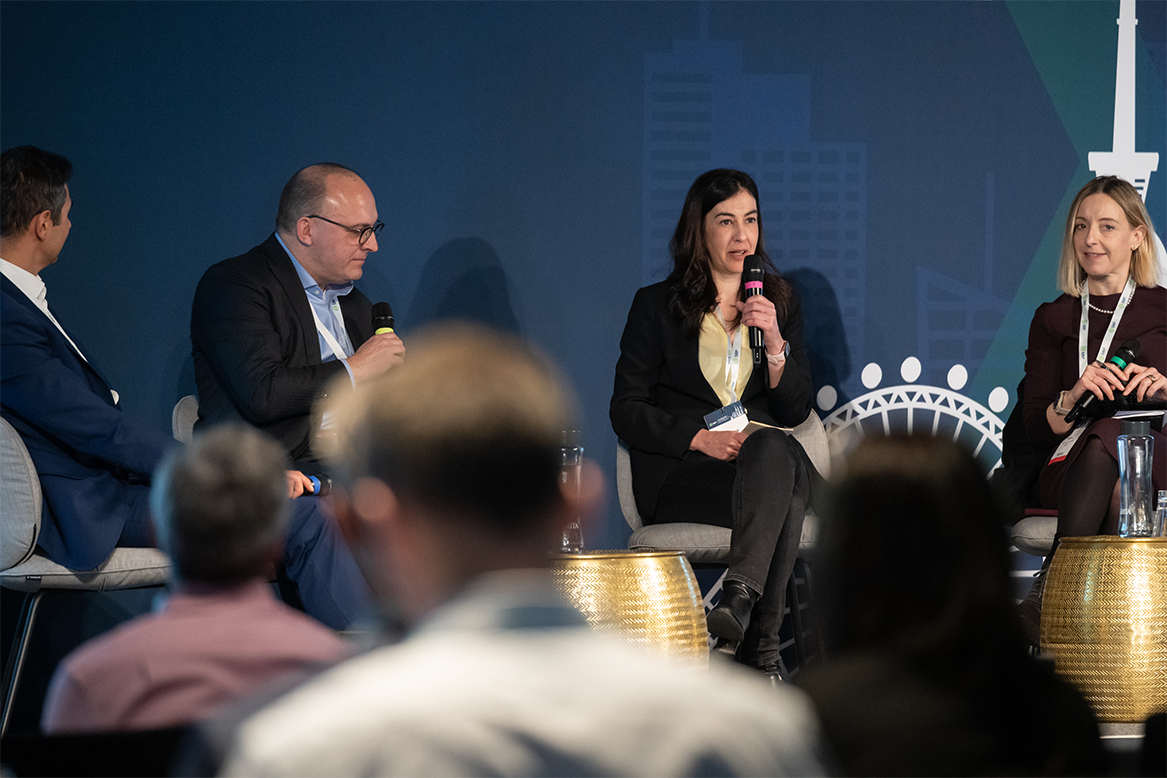
From left to right: Michał Karwasiński, Polish Council for Structured Products; Thomas Wulf, Eusipa; Pauline Laurent, AFPDB; Fulvia Lucantonio, Acepi.
Laurent admitted the current state of struggle to incorporate structured products into the ESG sustainable regulatory framework.
“The lack of definition of structured products doesn’t help – maybe it is about the fact that our products are hybrid products, so apart bonds, but also with the derivatives embedded. And these bond features make them difficult, for some regulators from the legislator’s point of view, to put in the square in the run,” she pointed out.
Fulvia Lucantonio (pictured), secretary general at the Italian Association of Certificates and Investment Products, or Acepi, noted that the regulatory landscape in Italy has become more “proactive.”
“It’s way quicker than it used to be in Italy – up to the point that there have been a lot of Italian issuers that have reassured their activities,” said Lucantonio, who is also the head of issuances documentation legal advisory at Intesa Sanpaolo's Istituto Mobiliare Italiano corporate and investment banking (IMI CIB).
“The issues we are facing are mainly with the National legislator because on the other side, what we see from Parliament, for example, there has been the appointment of a commission to adapt and modify the applicable laws to finalise. The draft we’ve seen has [seen articles] doubled from 1998 to 2026,” Lucantonio said.
Defining rules for issuing financial instruments in a tokenised form from the fintech’s lens has been one of the challenges for the Italian market, Lucantonio noted.

From left to right: Michał Karwasiński, Polish Council for Structured Products; Thomas Wulf, Eusipa; Pauline Laurent, AFPDB; Fulvia Lucantonio, Acepi.
Meanwhile in Poland, the Committee doesn’t set out specific rules for structured products concerning complexity besides the European Union’s, said Michał Karwasiński, a member of the board for the Polish Council for Structured Products.
“We will not constrain this market; on the other hand, we will have a very strict eye on how you use these governance rules and how you protect those retail investors, especially in terms of complex instruments,” Karwasiński said.
When asked about thoughts on the Financial Data access (FiDA) regulation, a new proposed framework for open access to customer data across a wider range of financial services, Karwasiński pointed out Poland’s regulator’s opposition stance against such rules.
“[Our regulator] is afraid that this automation of data transfer would result in outflow of clients from Polish, Czech, or Slovak distributors to British, Estonian or Lithuanian fintechs, which are much better prepared for retail investors and services,” he said, adding he still sees the FiDa might change in automation for user experience.

From left to right: Michał Karwasiński, Polish Council for Structured Products; Thomas Wulf, Eusipa; Fulvia Lucantonio, Acepi.
A permanent regulation on tax preferences, or so-called ‘personal investment accounts,’ is currently in the process in Poland, with such rules would allow the investment of €25,000 (US$27,500) per year to be “almost exempted from income tax on capital gains,” Karwasiński explained.
“As an association, we are fighting to include [structured products as instruments] in those personal investment accounts... But it is relatively fighting a battle that cannot be won because the vast majority of structured products are not listed,” he concluded.
Do you have a confidential story, tip or comment you’d like to share? Contact Us | SRP (structuredretailproducts.com)