The bank’s US wealth management business, Engle volatility-control index series and Brazilian credit-linked note have received industry awards, highlighting innovation across three areas of its offering as UBS develops its business following the Credit Suisse integration.
UBS is seeing growth in its Americas structured products business following the integration of Credit Suisse, with industry awards recognising innovation across its US wealth management platform, volatility-control index research and Brazilian onshore offering.
The breadth of adoption reflects strong demand for research-driven solutions that aim at enhance risk management and investment outcomes - Ghali El Boukfaoui
The three award-winning initiatives illustrate the breadth of UBS’s structured products activities rather than a single strategy. They span an AI-themed structured note distributed to US wealth management clients, the Engle Index Series, which applies academic research to volatility control and an issuer-callable credit-linked note (CLN) developed for Brazil’s domestic market.
In the US, UBS Wealth Management was named Best Private Bank, Americas, while the three-year AI-themed catapult note issued by Goldman Sachs for UBS clients received the Deal of the Year, USA, award. The Engle Index Series won the Index Research & Innovation award and UBS’s Brazil Onshore Issuer-Callable Credit-Linked Note received Most Innovative Product, Brazil.
Together, the awards highlight different aspects of the bank’s approach to structured products, from thematic investment and portfolio construction to risk management and yield enhancement.
Translating volatility research into investable strategies
The Engle Index Series, which includes certain indices sponsored by UBS as well as indices sponsored by third-party index providers, applies volatility forecasting techniques to index construction, with the aim of improving risk management and risk-adjusted investment outcomes.
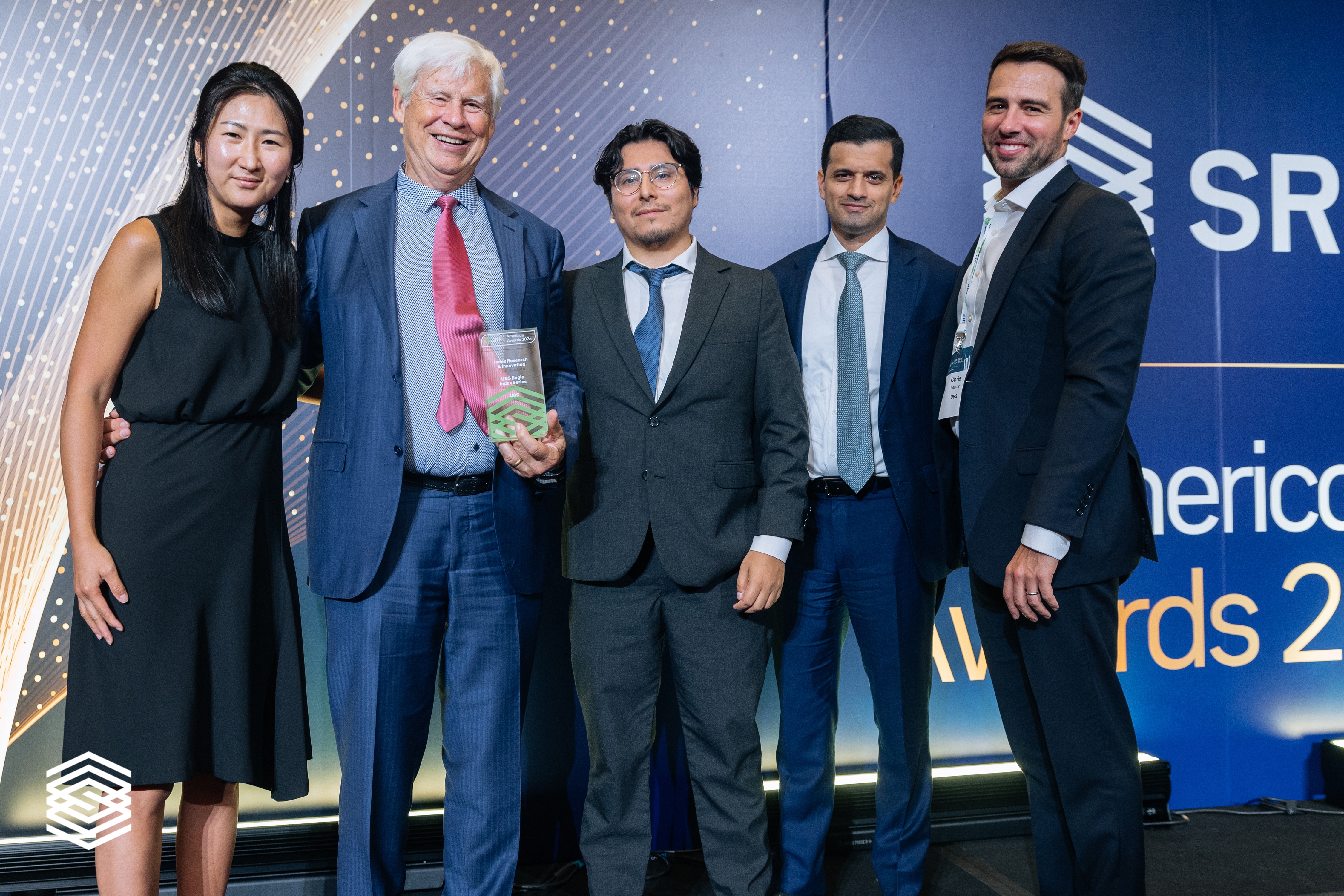
The UBS team at the SRP Americas 2026 Awards in Scottsdale, Arizona on 23 September 2026 with Professor Robert F. Engle second from left and Ghali El Boukfaoui second from right.
The methodology is a variation of GARCH models associated with economist Robert Engle, whose work on volatility modelling was recognised with the Nobel Prize in Economic Sciences. UBS adapted the approach for volatility-targeting applications, drawing on research explored in a Journal of Portfolio Management paper co-authored by Engle.
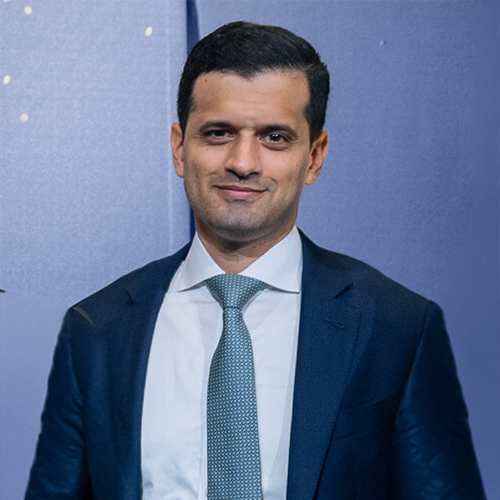
“The UBS Engle methodology adapts these forecasting techniques specifically for volatility-targeting applications, with the goal of incorporating research based volatility estimators into the index construction process,” Ghali El Boukfaoui (pictured), head of insurance sales at UBS, told SRP.
The premise is that more accurate volatility forecasts can support better decisions about portfolio risk and the allocation of exposure. The index series has been adopted across asset classes and regions, including strategies in the US and Asia used in indexed universal life products, fixed indexed annuities and structured products.
“As of September 2026, the Engle Volatility Control Series had been used in strategies across multiple asset classes and geographic regions, with approximately 12 index variants and nearly USD 1 billion notional value of options referencing the indices.” El Boukfaoui said.
“The breadth of adoption reflects strong demand for research-driven solutions that aim at enhance risk management and investment outcomes.”
Interest has also extended to multi-asset strategies, global approaches and variants designed for different markets. UBS sees potential to apply the methodology across a wider range of investment wrappers, including structured products, insurance products and derivative-based ETFs.
“We believe academically informed investment strategies may have broader applications across these segments, particularly for investors seeking differentiated and transparent approaches to risk management,” El Boukfaoui said.
The series received the Index Research & Innovation award, recognising UBS’s work in translating volatility research into investment strategies.
US wealth management: leveraging catapult structure
UBS Wealth Management’s structured products business in the Americas has benefited from both reinvestment of maturing products and new assets entering the market, according to Deepkumar Gandhi (below right), head of distribution for structured products in the Americas.
Investors need to understand how an index behaves during market drawdowns rather than focusing only on the coupon it offers - Deepkumar Gandhi
“We have seen growth from both rollovers and net new assets,” Gandhi said. “But an important part of the story for us is new assets coming into structured notes, supported by the performance these investments have delivered in client portfolios.”
The business focuses on structured notes and some warrants, serving high-net-worth and ultra-high-net-worth clients. Gandhi said investor education remains central to the distribution process, particularly as investors weigh the features of different structures and underlying indices.

“Investor education is essential, to understand available investment choices and to ensure best option is selected to achieve the goals of the portfolio,” he said. “Clients should understand the underlying index, wrapper and strategy before investing.”
Gandhi also urged caution around some structured exchange-traded products, particularly autocallable ETFs linked to indices that use rolling futures or decrement methodologies.
“Investors need to understand how an index behaves during market drawdowns rather than focusing only on the coupon it offers,” he said.
Within the notes business, contingent-yield structures remain popular, while bullet and point-to-point structures are used for growth-oriented exposure. The product mix also includes catapult structures, which Gandhi said can appeal to investors seeking upside while remaining conscious of market valuations and the possibility of a correction.
One example was an artificial-intelligence-themed catapult note issued by Goldman Sachs for UBS Wealth Management clients. Gandhi said the transaction was part of a broader thematic investment approach rather than a bespoke trade.
“It was not a bespoke transaction. This is a thematic artificial-intelligence investment that UBS had been doing since 2023, based on CIO research and a basket of more than 20 names.”
The transaction offered exposure to 27 equally weighted stocks spanning semiconductors, hardware, software and infrastructure. The basket included companies such as Nvidia, Taiwan Semiconductor Manufacturing Company, Broadcom, AMD, ASML, Microsoft, Alphabet, Meta Platforms, Amazon and Arm.
Equal weighting was intended to avoid excessive concentration in the largest technology companies and provide exposure across the AI value chain.
“The idea was to offer exposure to AI through a diversified group of companies, complementing clients’ existing holdings, rather than simply concentrating exposure in a few familiar names,” Gandhi said.
The 53-week note featured a 25% call return if the basket was at or above its initial level on the autocall observation. If the note was not called, it offered 165.35% uncapped participation at maturity, subject to a European knock-in barrier at 75% of the initial basket level, observed at maturity, for principal protection.
Goldman Sachs was selected as issuer because of its ability to manage and hedge the large basket.
The transaction was named Deal of the Year, USA. UBS Wealth Management also received the Best Private Bank, Americas award.
Gandhi said clients were increasingly using analytics to compare transactions, assess fees, select underlyings and run backtests. He expects pressure on manufacturing margins to continue as investors become more focused on how a product fits into their portfolios.
“Clients are using analytical tools to compare and rank transactions, assess fees, select underlyings and run backtests,” he said.
“Our approach is to align transactions with CIO views and the role an investment is intended to play in a portfolio. Performance matters more than sales or terms.”
Brazil: combining credit-linked exposure with a callable feature
In Brazil, UBS has focused on meeting demand for yield-enhancing investments.
Demand has remained strongly focused on yield-enhancing strategies, particularly credit-linked solutions - Catalina Serrano Rosero
The bank distributed an onshore issuer-callable credit-linked note (CLN) to build on investors’ familiarity with credit-linked strategies held in offshore portfolios, while introducing a structure designed for the domestic market.

Catalina Serrano Rosero at the SRP Americas 2026 Awards in Scottsdale, Arizona on 23 September 2026.
“The Brazil Onshore Issuer-Callable CLN was developed to help investors generate additional yield at a time when investment-grade credit spreads in the local market were tightening, despite interest rates remaining at historically high levels,” said Catalina Serrano Rosero, structured products & derivatives at UBS.
The product combined an onshore CLN with an issuer-callable feature, a combination that UBS described as unprecedented in the Brazilian market. The callable feature was designed to capture an additional yield premium by monetising elevated yield levels and interest-rate volatility, while retaining exposure to a familiar credit-linked structure.
“The addition of the callable feature to the onshore CLN enabled investors to capture an additional yield premium by monetizing elevated yield levels and interest rate volatility, while maintaining exposure to a credit-linked structure with which they were already familiar,” Serrano Rosero said.
The note also incorporated a linear coupon. According to UBS, this helped increase the annual coupon while potentially shortening the expected weighted average life.
Demand in the local market continues to centre on yield-enhancing and credit-linked strategies, although UBS sees interest expanding into other types of structured investments.
“Demand has remained strongly focused on yield-enhancing strategies, particularly credit-linked solutions,” Serrano Rosero said. “At the same time, interest is expanding beyond credit-linked products to include a broader range of cross-asset structured solutions.”
Looking ahead, UBS expects investors to seek more diversification and access to a broader range of investment opportunities. The bank aims to combine its global capabilities with the needs of Brazilian investors and the characteristics of the local market.
The onshore issuer-callable credit-linked note received the Most Innovative Product, Brazil award.
Image: Adobe Stock
| UBS won the award for ‘Best Private Bank, Americas’, ‘Most Innovative Product, Brazil’, and ‘Index Research & Innovation’. Click the link to view all the winners. |